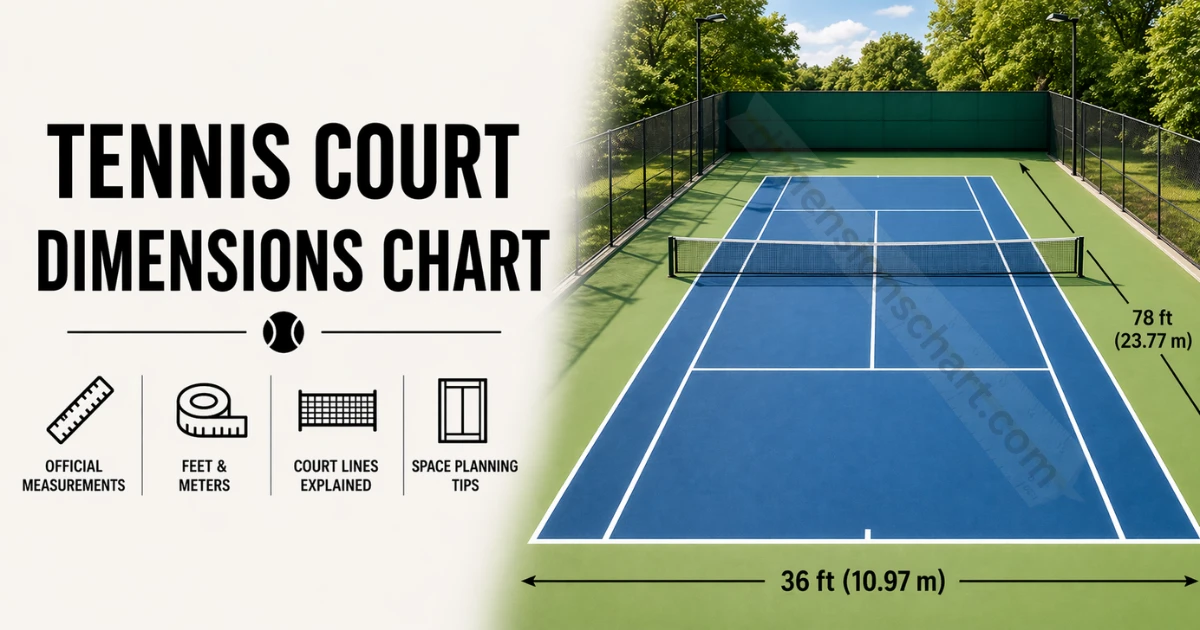
Whether you’re building a court, planning a facility, or just getting serious about the game — knowing the exact tennis court dimensions is essential. Wrong measurements mean wrong play.
This guide gives you a clear tennis court dimensions chart, every line explained, and practical space planning tips — all in one place.
Standard Tennis Court Dimensions — Singles and Doubles
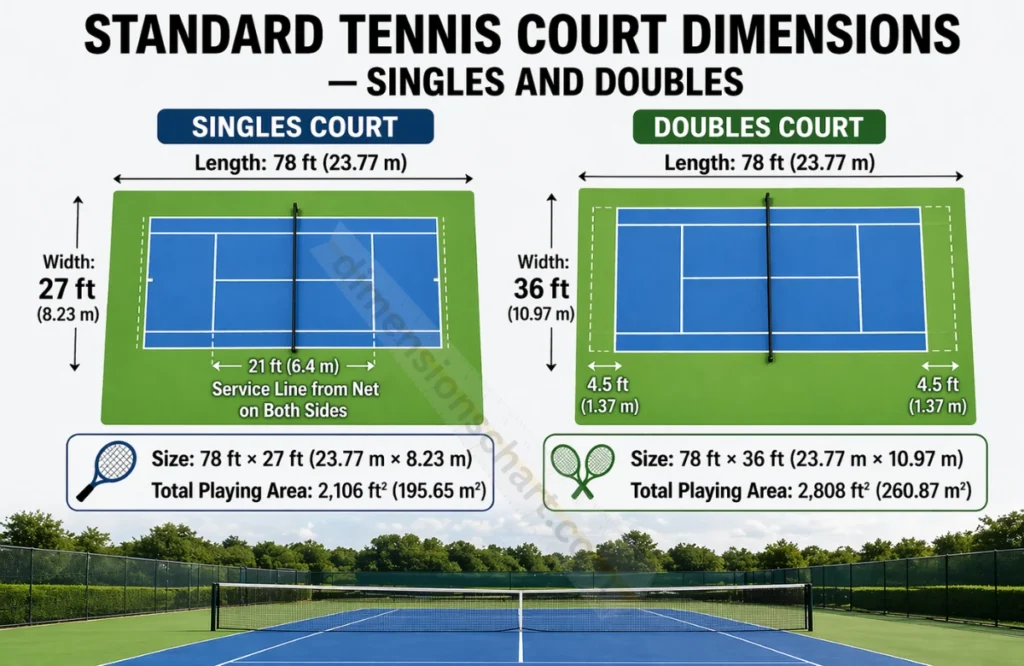
Every professional court follows the same ITF-regulated standard size. The total length is always 78 feet (23.77 m) — for both singles and doubles. What changes is the width.
Singles and doubles courts share the same baseline. Only the side boundaries differ, defined by the doubles alleys on each side.
Singles Tennis Court Dimensions
A singles court measures 78 ft long × 27 ft wide (23.77 m × 8.23 m). The service line sits exactly 21 ft (6.4 m) from the net on both sides. Total playing area is 2,106 ft² (195.65 m²).
Doubles Tennis Court Dimensions
A doubles court measures 78 ft long × 36 ft wide (23.77 m × 10.97 m). The extra 4.5 ft (1.37 m) on each side forms the doubles alley. Total playing area reaches 2,808 ft² (260.87 m²).
| Court Measurement | Feet | Meters |
|---|---|---|
| Overall Length | 78 ft | 23.77 m |
| Singles Width | 27 ft | 8.23 m |
| Doubles Width | 36 ft | 10.97 m |
| Service Line Distance (from net) | 21 ft | 6.40 m |
| Doubles Alley Width (each side) | 4.5 ft | 1.37 m |
| Net Height — Center | 3 ft | 0.91 m |
| Net Height — Posts | 3 ft 6 in | 1.07 m |
| Net Post Placement (outside court) | 3 ft | 0.91 m |
| Baseline Width (line thickness) | min. 4 in | min. 10 cm |
| Other Line Width | min. 2 in | min. 5 cm |
| Minimum Total Space (with clearance) | 120 × 60 ft | 36.58 × 18.29 m |
| Total Area with Clearance | 7,200 ft² | 668.9 m² |
| Tournament Court Total Space | 130 × 70 ft | 39.62 × 21.34 m |
Tennis Court Markings and Lines Explained
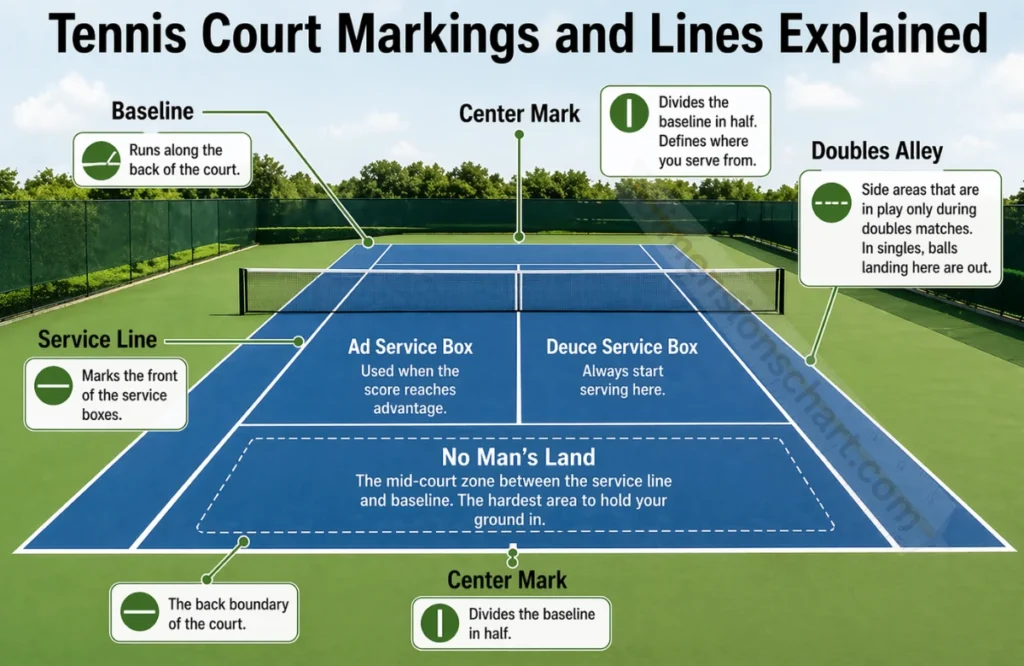
Every line on a regulation tennis court has a specific purpose. Understanding the court markings improves both play and planning.
The baseline runs along the back of the court. The center mark divides it in half, defining where you serve from.
Service Boxes, Baselines, and Doubles Alleys
The deuce service box is on the right side of the court — you always start serving here. The ad service box is on the left, used when the score reaches advantage.
“No man’s land” is the informal name for the large mid-court zone between the service line and baseline. It’s the hardest area to hold your ground in. Doubles alleys are only in play during doubles matches — in singles, balls landing there are out.
Net Height and Post Dimensions
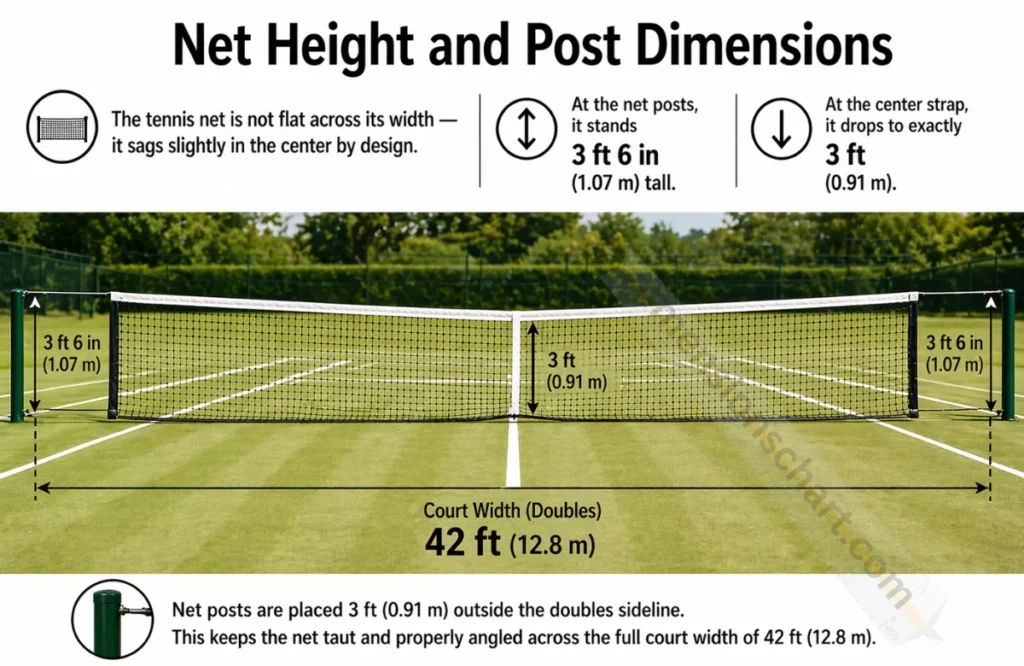
The tennis net is not flat across its width — it sags slightly in the center by design. At the net posts, it stands 3 ft 6 in (1.07 m) tall. At the center strap, it drops to exactly 3 ft (0.91 m).
Net posts are placed 3 ft (0.91 m) outside the doubles sideline. This keeps the net taut and properly angled across the full court width of 42 ft (12.8 m).
How Much Space Do You Need for a Tennis Court?
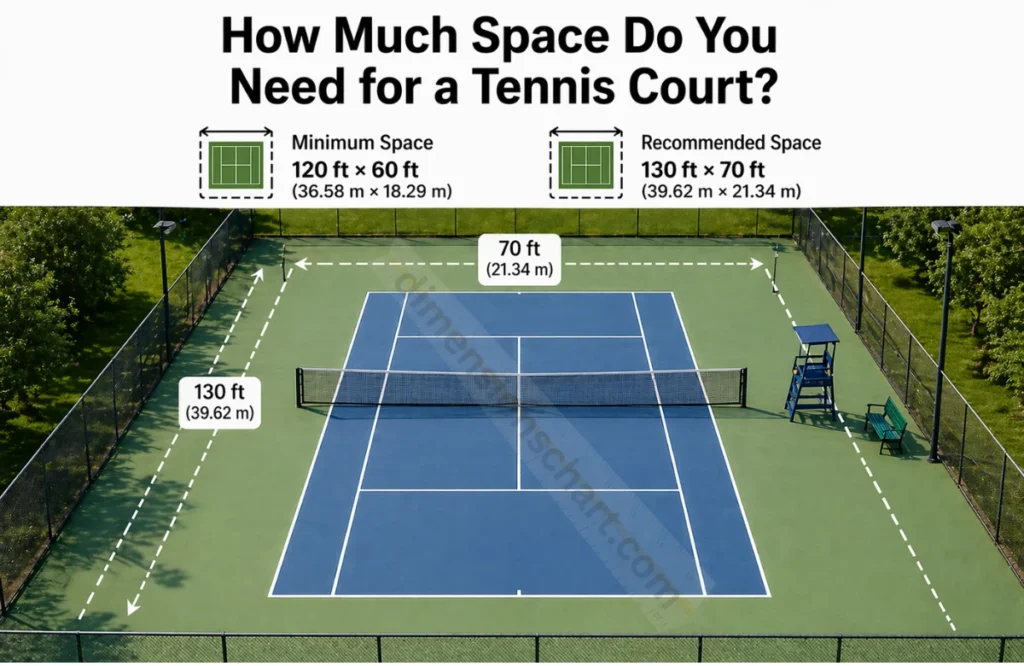
Fitting a full tennis court takes more land than most people expect. The playing surface alone isn’t enough — you need safe run-back and side clearance around it.
A standard recreational court requires a minimum footprint of 120 ft × 60 ft (36.58 m × 18.29 m) — that’s roughly 7,200 ft² (668.9 m²). For a tournament-grade court with full player overrun and umpire access, plan for 130 ft × 70 ft (39.62 m × 21.34 m), totaling around 9,100 ft² (845 m²).
Hard courts (asphalt or concrete with acrylic surfacing) are the most popular and cost-effective choice across the USA. They need far less maintenance than clay or grass courts and perform consistently across all weather conditions. According to the USTA, hard courts are the most widely used court surface type in American facilities.
Conclusion
Understanding the tennis court dimensions chart is the foundation — whether you’re playing, coaching, or building. Every measurement has a purpose, and every line tells you exactly where the game is won or lost.
Use this guide as your go-to court dimensions reference — from the baseline to the net, from singles to doubles, in feet and meters.
FAQ’s
What are the dimensions of a tennis court?
A standard tennis court is 78 ft (23.77 m) long. It is 27 ft (8.23 m) wide for singles and 36 ft (10.97 m) wide for doubles. The service line is 21 ft (6.4 m) from the net on each side.
Is there a standard size for tennis courts?
Yes. The ITF (International Tennis Federation) sets the global standard for court dimensions. All professional ATP, WTA, and recreational courts follow the same measurements — only the surface material differs between grass, clay, and hard courts.
What is the oldest racket sport?
Real Tennis — also called Royal Tennis — is the oldest racket sport, dating back to 12th-century France. It was first played by hand as “Jeu de Paume.” Modern lawn tennis was invented in 1873 by Major Walter Wingfield.
How much space do you need to build a tennis court?
You need a minimum of 120 ft × 60 ft (36.58 m × 18.29 m) — roughly 7,200 ft² (668.9 m²). A full tournament court with proper clearance requires 130 ft × 70 ft (39.62 m × 21.34 m).
What is the cheapest way to build a tennis court?
A hard court with an asphalt or concrete base topped with acrylic resurfacing is the most budget-friendly option. It’s low maintenance, highly durable, and costs significantly less to install and upkeep compared to clay or grass courts.
What is the 80/20 rule in tennis?
The 80/20 rule means 80% of your results come from 20% of your skills. In tennis, that’s your serve and groundstrokes — master those two, and you win the majority of your points. Focus beats volume every time.
What are the 4 pillars of tennis?
The four pillars are technical (stroke mechanics), tactical (court strategy), physical (speed and endurance), and mental (focus and resilience under pressure). Elite players develop all four simultaneously.

Burhan Ali is the founder and author of DimensionsChart.com, providing accurate size charts, measurements, and guides for smarter buying decisions.