Choosing the wrong pallet size costs you money. It wastes trailer space, causes freight reclassification, and slows down your warehouse operations.
This guide gives you every standard pallet dimension, a full pallet sizes chart, and the facts you need to ship smarter across the US.
What Are Standard Pallet Dimensions in the US?
What Are Standard Pallet Dimensions in the US?
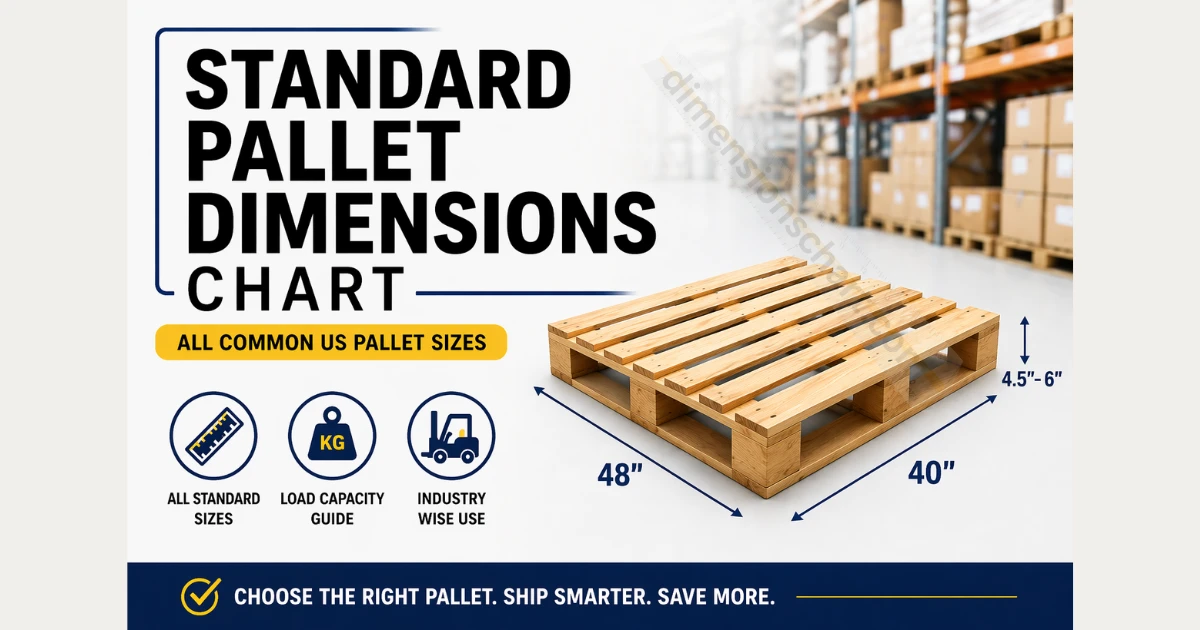
In the United States, the standard pallet size is 48″ × 40″ — known as the GMA pallet. It accounts for roughly 30% of all new wood pallets produced in the country.
Standard Pallet Dimensions in Inches
The 48 × 40 pallet is the backbone of US retail, grocery, and warehousing supply chains.
It works perfectly with racking systems, forklifts, and pallet jacks.
Most 53-foot trailers are designed around this size — fitting up to 26 pallets per load.
Standard Pallet Dimensions in CM and MM
| Unit | Length | Width |
|---|---|---|
| Inches | 48″ | 40″ |
| Centimeters | 121.9 cm | 101.6 cm |
| Millimeters | 1,219 mm | 1,016 mm |
Euro Pallet (EPAL)
Used in Europe for international shipping.
Size: 120 cm × 80 cm
ISO Standard Pallet
Common global standard for logistics and exports.
Size: 120 cm × 100 cm
Standard Pallet Dimensions Chart (All Common US Sizes)
Not every industry uses the 48×40. Here is the complete pallet dimensions chart used across US supply chains. Use this chart to match your load, your industry, and your equipment every time.
Pallet Dimensions Comparison Chart
| Pallet Size | Top Deck Boards | Max Load Capacity | Avg Weight | Common Industry |
|---|---|---|---|---|
| 48″ × 40″ | 7 | 4,592 lbs | 37 lbs | Grocery, Warehousing |
| 42″ × 42″ | 7 | 4,445 lbs | 36 lbs | Telecom, Paint, Military |
| 48″ × 48″ | 6 | 4,673 lbs | 37 lbs | Chemical, Drum Storage |
| 40″ × 48″ | 7 | 3,696 lbs | 42 lbs | Retail, Distribution |
| 48″ × 42″ | 7 | 4,333 lbs | 35 lbs | Mixed Use |
| 40″ × 40″ | 6 | 3,544 lbs | 29 lbs | Dairy, Beverage |
| 36″ × 36″ | 6 | 3,544 lbs | 32 lbs | Beverage |
| 48″ × 36″ | 6 | 5,261 lbs | 31 lbs | Military |
| 42″ × 31″ | 6 | 6,585 lbs | 33 lbs | Military, Specialty |
| 48″ × 45″ | — | Custom | — | Automotive |
| 44″ × 56″ | — | Custom | — | Glass / Can Industry |
Four-Way Pallets
- Access: all sides
- Benefit: faster handling
- Use: tight warehouse spaces
- Insight: Forklift access from all sides makes it faster and more flexible in tight warehouse spaces.
↔ Two-Way Pallets
- Access: two sides only
- Benefit: simple design
- Limitation: less flexible movement
- Insight: Only two-side access limits flexibility compared to four-way pallets.
Standard Pallet Sizes by Industry
Different industries use specific pallet sizes based on load type, weight, and handling systems. Choosing the right one improves efficiency and avoids costly mismatches.
🛒 Grocery / GMA Pallets (48″ × 40″)
- The GMA 48×40 pallet is the gold standard for US grocery and retail supply chains.
- Grade A: Clean, no repairs | Grade B: Used but cost-effective.
🚗 Automotive Pallets (48″ × 45″)
- Designed for heavy and irregular parts like engine blocks and body components.
- Often custom-built for specific automotive assembly requirements.
🧪 Chemical & Pharmaceutical (48″ × 48″)
- Used for drum storage and chemical transport across global supply chains.
- Plastic pallets preferred due to resistance against chemicals and contamination.
🍾 Beverage & Glass (36″ × 36″, 44″ × 56″)
- Compact pallets for fast beverage handling and large heavy-load glass shipments.
- Built for stability, speed, and high-volume distribution.
Types of Pallets and Deck Configurations
Pallet type affects handling, strength, and cost. Understanding each design helps choose the right option for your supply chain.
Stringer Pallets
Use three horizontal 2×4″ boards along length.
Most common in North America. Available as two-way or partial four-way (notched).
Best for heavy freight in standard warehouses.
Block Pallets
Made with solid wood blocks between top and bottom decks.
True four-way forklift access from all sides.
Stronger and preferred in automated systems.
Skid Pallets
Simple design with single top deck only.
Lightweight and cost-effective.
Used where bottom access not required.
Quick Deck Modification Reference
| Modification | What It Means |
|---|---|
| Solid Deck | No gaps, smooth surface for small or unstable items |
| Double Face | Top + bottom boards for better weight distribution |
| Winged Pallet | Overhanging boards for larger loads |
| Double Wing | Both top and bottom extend beyond frame |
How to Pick the Right Pallet Size for Your Shipment
The right pallet size reduces freight costs, prevents product damage, and keeps your warehouse running efficiently. Here is how to choose correctly.
| Factor | What to Check |
|---|---|
| Product Dimensions | Pallet must fully support the load — zero overhang |
| Total Cargo Weight | Must fall below the pallet’s max load capacity |
| Warehouse Racking | Confirm pallet fits your existing rack system |
| Freight Type | LTL vs FTL impacts how pallet dimensions affect freight class |
| Forklift Access | Tight spaces need four-way entry pallets |
| International Shipping | Euro pallets (120×80 cm) or ISO standard (120×100 cm) may be required |
Conclusion
Standard pallet dimensions are not just numbers — they directly affect your freight costs, warehouse space, and shipping efficiency.
Use the standard pallet dimensions chart in this guide to match the right pallet to your load, industry, and shipping route. When in doubt, the 48×40 GMA pallet is the proven default for US operations.
FAQ’s
What is the standard size of pallets?
The standard pallet size in the US is 48″ × 40″, known as the GMA pallet. It accounts for about 30% of all new wood pallets made in America and is used across grocery, retail, and general warehousing.
What is the height of a 40×48 pallet?
A 40×48 pallet stands 4.5 to 6 inches tall when empty. With cargo loaded, total palletized freight height typically ranges between 48 and 60 inches — the safe maximum for most trailers.
What is the standard pallet size in cm?
The US standard pallet measures 121.9 cm × 101.6 cm (48″×40″). In Europe, the Euro pallet is 120 cm × 80 cm. For ISO international shipping, the most common size is 120 cm × 100 cm.
How many 48×40 pallets fit in a box truck?
A 26-foot box truck holds 12 to 14 standard 48×40 pallets in a single layer. A 53-foot dry van trailer fits approximately 26 pallets in a straight-row layout.
How to calculate pallet size?
Measure your largest product’s footprint, choose a pallet that fully supports it, and confirm the total cargo weight stays below the pallet’s max load capacity. For the 48×40 GMA pallet, that limit is 4,592 lbs.
How many pallets per 40ft?
A standard 40-foot ISO container holds about 20 standard 48×40 pallets per layer. Euro pallets, being smaller, can fit up to 25 per 40ft container. Always cross-check pallet count against the container’s max gross weight limit of approximately 26,500–28,000 kg.

Burhan Ali is the founder and author of DimensionsChart.com, providing accurate size charts, measurements, and guides for smarter buying decisions.