Choosing the right truck cap starts with knowing your exact bed dimensions. A cap that doesn’t fit properly won’t seal correctly, can leak, and may even damage your truck’s paint. This guide provides accurate truck cap dimensions for all major manufacturers.
Whether you drive a Ford, Chevy, RAM, or Toyota, getting the correct measurements prevents costly mistakes. Most truck owners don’t realize that bed sizes changed significantly between model years, making a dimensions chart essential before any purchase.
Truck Cap Dimensions and Sizing Basics
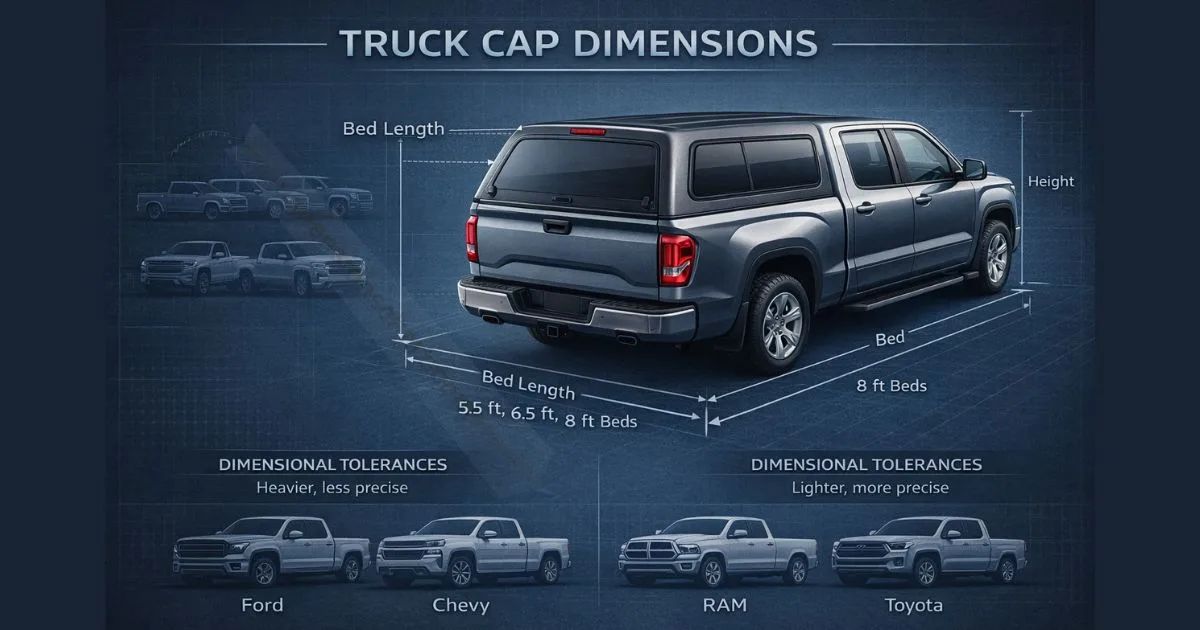
Truck cap measurements include three critical numbers: bed length, width, and height. The bed length measures from the inside of the bulkhead to the inside of the tailgate. This determines which cap size you need – typically 5′, 6′, or 8′ boxes.
Width measurements matter just as much as length. Most full-size trucks measure between 50″ to 71″ wide at the bed rails. The cap must match your truck’s specific width to create a proper seal against weather and dust.
Height specifications vary by cap style. Standard caps sit flush with the cab roofline, while high-rise caps add 12″ to 18″ of extra clearance inside. Your truck’s cab height determines which cap style maintains the best aerodynamics and appearance.
Complete Truck Cap Dimensions Chart
| Make/Model | Year Range | Bed Size | Inside Length | Outside Width | Inside Width (at rail) | Cab Configuration |
|---|---|---|---|---|---|---|
| FORD F-150 | ||||||
| F-150 | 2015-2024 | 5.5′ Box (Short) | 67″ | 80″ | 65″ | SuperCrew |
| F-150 | 2015-2024 | 6.5′ Box (Standard) | 79″ | 80″ | 65″ | SuperCab, SuperCrew |
| F-150 | 2015-2024 | 8′ Box (Long) | 97″ | 80″ | 65″ | Regular Cab |
| F-150 | 2009-2014 | 5.5′ Box | 67-70″ | 80″ | 65″ | SuperCrew |
| F-150 | 2009-2014 | 6.5′ Box | 79″ | 80″ | 65″ | All Cabs |
| FORD SUPER DUTY (F-250/F-350) | ||||||
| Super Duty | 2017-2024 | 6.75′ Box | 81.75″ | 80″ | 69″ | All Cabs |
| Super Duty | 2017-2024 | 8′ Box | 98″ | 80″ | 69″ | Crew, Regular |
| Super Duty | 2011-2016 | 6.75′ Box | 81.75″ | 80″ | 69″ | All Cabs |
| Super Duty | 2011-2016 | 8′ Box | 98″ | 80″ | 69″ | Crew, Regular |
| CHEVROLET/GMC SILVERADO/SIERRA | ||||||
| Silverado/Sierra | 2019-2024 | 5’8″ Box (Short) | 69.3″ | 71.4″ | 63.25″ | Crew Cab |
| Silverado/Sierra | 2019-2024 | 6.5′ Box (Standard) | 79.4″ | 71.4″ | 63.25″ | Double, Crew Cab |
| Silverado/Sierra | 2019-2024 | 8′ Box (Long) | 96.5″ | 71.4″ | 63.25″ | Regular, Double Cab |
| Silverado/Sierra | 2014-2018 | 5’8″ Box | 69.3″ | 71.4″ | 62.4″ | Crew Cab |
| Silverado/Sierra | 2014-2018 | 6.5′ Box | 78.7″ | 71.4″ | 62.4″ | All Cabs |
| Silverado/Sierra | 2014-2018 | 8′ Box | 96.5″ | 71.4″ | 62.4″ | Regular, Double Cab |
| RAM 1500/2500/3500 | ||||||
| RAM 1500 | 2019-2024 | 5’7″ Box (Short) | 67.4″ | 71.4″ | 66.4″ | Crew Cab |
| RAM 1500 | 2019-2024 | 6’4″ Box (Standard) | 76.3″ | 71.4″ | 66.4″ | Quad, Crew Cab |
| RAM 1500 | 2019-2024 | 8′ Box (Long) | 98.3″ | 71.4″ | 66.4″ | Regular Cab |
| RAM 1500 | 2009-2018 | 5’7″ Box | 65.5″ | 72.75″ | 62″ | Crew Cab |
| RAM 1500 | 2009-2018 | 6.5′ Box | 74.25″ | 72.75″ | 65.4″ | Quad, Crew Cab |
| RAM 2500/3500 | 2010-2024 | 6.4′ Box | 76.3″ | 73.5″ | 68″ | Crew Cab |
| RAM 2500/3500 | 2010-2024 | 8′ Box | 98.3″ | 73.5″ | 68″ | Regular, Crew Cab |
| TOYOTA TUNDRA | ||||||
| Tundra | 2022-2024 | 5.5′ Box (Short) | 65.6″ | 71.4″ | 66.4″ | CrewMax |
| Tundra | 2022-2024 | 6.5′ Box (Standard) | 77.1″ | 71.4″ | 66.4″ | Double Cab, CrewMax |
| Tundra | 2022-2024 | 8′ Box (Long) | 98.2″ | 71.4″ | 66.4″ | Double Cab |
| Tundra | 2014-2021 | 5.5′ Box | 64.75″ | 71.25″ | 62.5″ | CrewMax |
| Tundra | 2014-2021 | 6.5′ Box | 77″ | 71.25″ | 62.5″ | Double Cab |
| Tundra | 2014-2021 | 8′ Box | 97.6″ | 71.25″ | 62.5″ | Double Cab |
| TOYOTA TACOMA | ||||||
| Tacoma | 2016-2024 | 5′ Box (Short) | 60.5″ | 65″ | 56.7″ | Access, Double Cab |
| Tacoma | 2016-2024 | 6′ Box (Long) | 73.7″ | 65″ | 56.7″ | Access, Double Cab |
| Tacoma | 2005-2015 | 5′ Box | 60.5″ | 60.25″ | 57.1″ | Access Cab |
| Tacoma | 2005-2015 | 6′ Box | 73.5″ | 60.25″ | 57.1″ | Access, Double Cab |
| NISSAN TITAN | ||||||
| Titan | 2016-2024 | 5.5′ Box (Short) | 67.1″ | 71.25″ | 65.5″ | King, Crew Cab |
| Titan | 2016-2024 | 6.6′ Box (Standard) | 79.5″ | 71.25″ | 65.5″ | King, Crew Cab |
| Titan XD | 2016-2024 | 6.6′ Box | 79.5″ | 71.25″ | 65.5″ | King, Crew Cab |
| Titan | 2004-2015 | 5.5′ Box | 65.4″ | 71.25″ | 61.25″ | King, Crew Cab |
| Titan | 2004-2015 | 6.5′ Box | 77.25″ | 71.25″ | 61.25″ | King Cab |
- All measurements are approximate and may vary by specific trim level
- Inside width measurements are taken at the bed rails, not between wheel wells
- Heavy-duty models (F-250+, RAM 2500+) may have wider beds than standard models
- Always verify exact dimensions with your truck’s VIN or owner’s manual before ordering a cap
- Stepside/Flareside beds require specialized caps and are not included in this chart
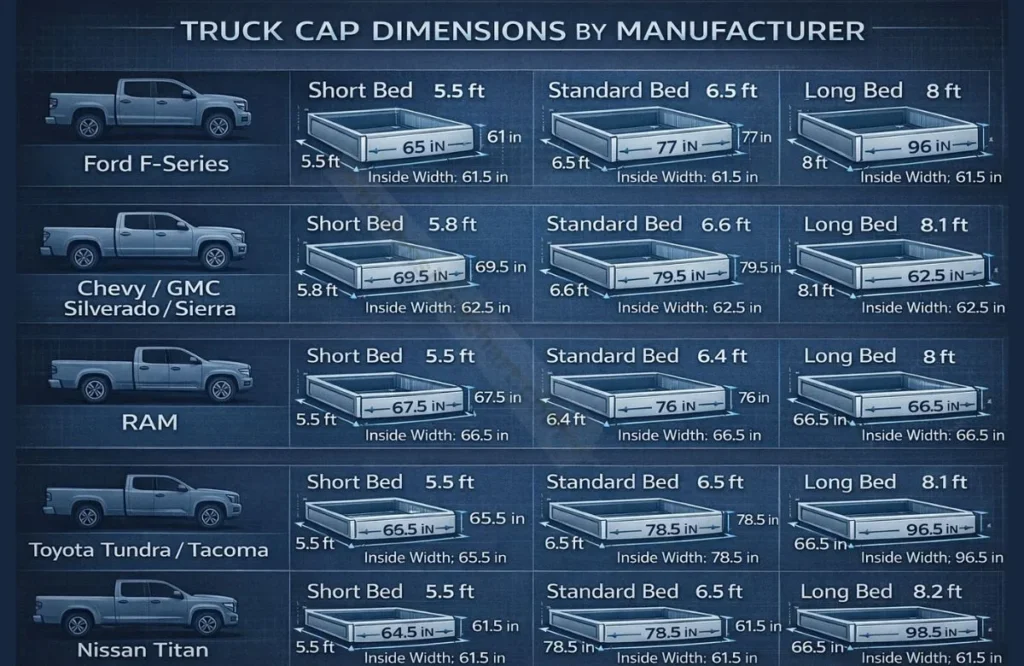
Complete Truck Cap Dimensions Chart by Manufacturer
Ford F-Series Truck Cap Dimensions
Ford F-150 trucks come in three distinct bed lengths. The short bed measures 67 inches inside length with a 5.5-foot box. This size became standard on SuperCrew models starting in 2015.
The standard 6.5-foot bed provides 78-79 inches of inside length. Regular cab and SuperCab F-150 models typically feature this size. Outside width measures approximately 73 inches across the bed rails.
Long bed F-150s offer 96-97 inches of interior space with an 8-foot box. These beds measure 100.5 inches outside length. Only Regular Cab configurations come with this option on modern F-150s.
Ford Super Duty trucks (F-250, F-350, F-450) use different dimensions than F-150 models. The 6.75-foot bed measures 81.75 inches inside, while the 8-foot bed provides 98 inches of usable length. Super Duty beds are also 2-3 inches wider than F-150 beds at 69 inches between wheel wells.
Chevy/GMC Silverado/Sierra Cap Sizing
Chevrolet Silverado and GMC Sierra share identical bed dimensions. The short bed measures 69.3 inches inside (5’8″ box) and fits Crew Cab models from 2014-present. Outside width reaches 71.4 inches at the rails.
The standard 6.5-foot bed offers 79.4 inches of interior length. This size works with Double Cab and some Crew Cab configurations. Width between wheel wells measures 62.4 inches, perfect for hauling sheet goods.
Long bed models provide 96.5-97 inches inside with an 8-foot box. Regular Cab and some Double Cab trucks feature this length. Outside dimensions reach 100.5 inches total length.
GM trucks from 1999-2013 used slightly different measurements. The Stepside bed measured 77.6 inches inside but only 49 inches wide between the wheel wells. These beds require specialized caps that accommodate the exterior fender bulges.
RAM Truck Cap Dimensions
RAM 1500 pickups offer the most bed length options. The short 5’7″ box measures 67.4 inches inside and pairs exclusively with Crew Cab models. This became available in 2019 with the fifth-generation RAM redesign.
The mid-size 6’4″ bed provides 76.3 inches of usable space. Outside width measures 71.4 inches. This size fits both Quad Cab and Crew Cab configurations on 2019-newer models.
RAM’s 8-foot bed delivers 98.3 inches inside length. Only Regular Cab models come with this option. The bed width matches other RAM sizes at approximately 66 inches between wheel wells.
Heavy-duty RAM 2500 and 3500 trucks use the same bed lengths but feature reinforced construction. The beds measure 2 inches wider at the top rails for increased payload capacity. Caps designed for RAM 1500s won’t fit properly on HD models.
Toyota Tundra and Tacoma Cap Sizes
Toyota Tundra beds come in three configurations. The short 5.5-foot bed measures 65.6 inches inside on 2022-newer models. Double Cab configurations typically feature this size.
The standard 6.5-foot bed provides 77.1 inches of interior space. This works with Double Cab and some CrewMax models. Width measures 66.4 inches at the top of the bed rails.
Long bed Tundras offer 8-foot boxes with 98.2 inches inside. Only available on specific Regular Cab or Double Cab trims. These beds match American full-size dimensions for standard 4×8 sheet materials.
Toyota Tacoma trucks use completely different sizing. The short bed measures 60.5 inches inside (5-foot box), while the long bed provides 73.7 inches (6-foot box). Tacoma beds are 56.7 inches wide between wheel wells, significantly narrower than full-size trucks.
Nissan Titan Truck Cap Measurements
Nissan Titan full-size trucks simplified bed options compared to competitors. The standard 5.5-foot bed measures 67.1 inches inside length. This pairs with King Cab and Crew Cab models across all Titan generations.
The long 6.6-foot bed offers 79.5 inches of usable space. Width between wheel wells reaches 65.5 inches. This bed size works well for contractors who need extra length without going to an 8-foot configuration.
Titan XD models use identical bed dimensions to standard Titans despite the heavier-duty frame. The bed rail height sits 1.5 inches higher on XD models, which affects cap fitment. Always specify XD when ordering caps for these trucks.
How to Measure Your Truck Bed for a Cap
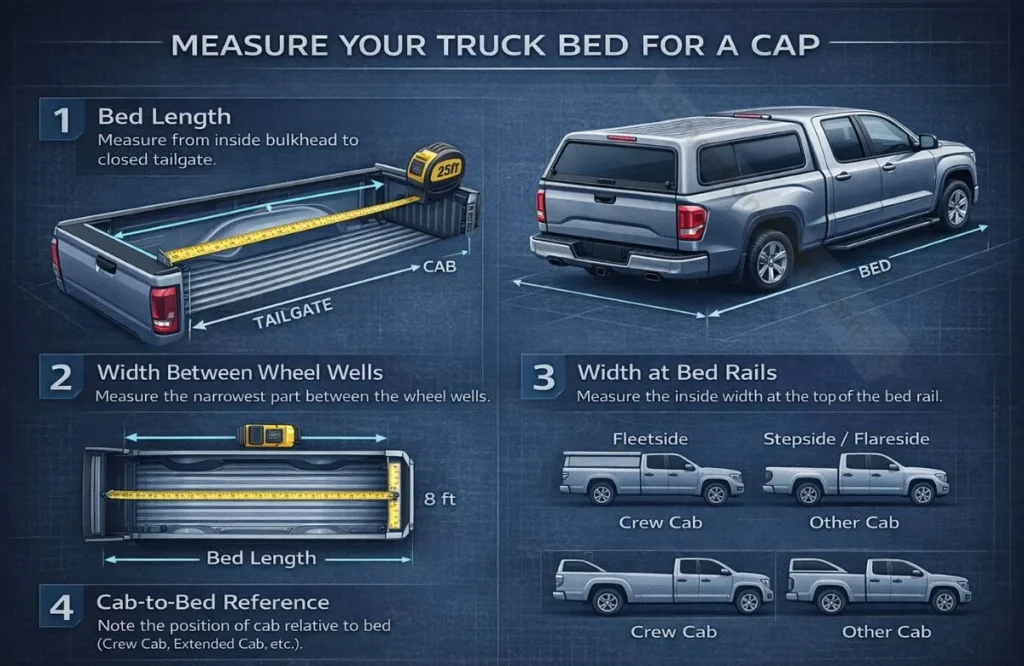
Start by measuring bed length from the inside front wall to the inside of the closed tailgate. Use a metal tape measure for accuracy – cloth tapes can stretch and give false readings. Round to the nearest half-inch.
Measure the width at three points: between the wheel wells, at the bed rail top, and at the cab back. The narrowest measurement determines which caps will fit. Most manufacturers design caps based on the wheel well width.
Check the bed style carefully before ordering. Fleetside beds have smooth sides, while Stepside beds feature protruding fenders. Some older Ford trucks used Flareside styling. Each style requires a completely different cap design.
Verify your cab configuration because it affects bed length. A Crew Cab with what appears to be a 6-foot bed might actually be a 5.5-foot or 5.8-foot box. Check your owner’s manual or the door jamb sticker for the official bed code.
Truck Cap Styles and Their Dimension Variations
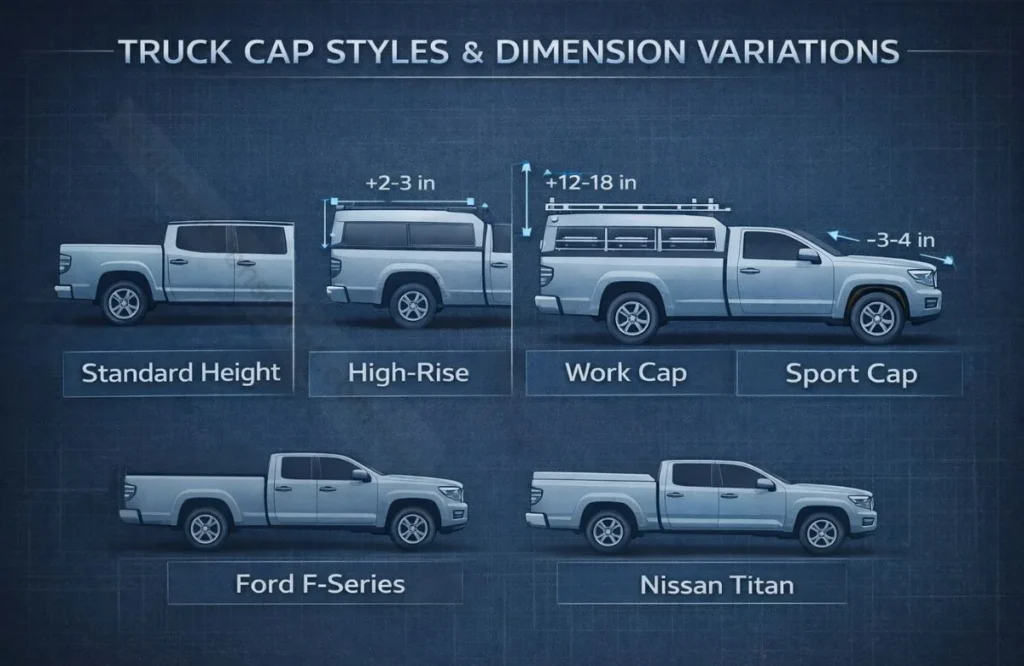
Standard height caps sit flush with your truck’s cab roofline. These maintain factory aerodynamics and typically add only 2-3 inches to overall vehicle height. They’re the most popular choice for daily drivers who want a clean, factory appearance.
High-rise caps add 12-18 inches of extra interior height. This allows you to stand up inside on most full-size trucks. The additional height increases wind resistance but provides significantly more usable cargo space for tall items.
Work caps feature aluminum or fiberglass construction with contractor-grade durability. These often include ladder racks, interior shelving, and reinforced roof structures. Dimensions match standard caps but with industrial-strength materials rated for heavy daily use.
Sport caps use aerodynamic designs with sloped rear windows. They typically measure 3-4 inches lower than the cab roofline for a sleek profile. While they reduce cargo height, sport caps improve fuel economy by reducing drag at highway speeds.
Conclusion
Getting accurate truck cap dimensions prevents installation problems and ensures proper weather sealing. Always measure your specific truck bed and verify the year range before purchasing any cap.
Use this dimensions chart as your starting reference, but confirm measurements with the cap manufacturer. The small investment in proper sizing saves hundreds in returns, modifications, or damage repairs down the road.
FAQs
How to size a truck cap?
Measure your truck bed from the inside front bulkhead to the inside of the closed tailgate. This gives you the bed length. Then measure the width between the bed rails at the top. Match these measurements to manufacturer specifications.
Check your truck’s VIN sticker or owner’s manual for the official bed size code. Most manufacturers use codes like “6.5” or “8.0” to indicate bed length. Always verify the year, make, and model when ordering because bed dimensions changed between generations.
Are all truck caps the same size?
No, truck caps vary significantly by manufacturer, model, and year. A Ford F-150 cap won’t fit a Chevy Silverado even if both have 6.5-foot beds. The width, mounting points, and contours differ between brands.
Even within the same brand, bed dimensions changed over time. A 2015 F-150 cap won’t fit a 2024 F-150 because Ford redesigned the bed structure. Always match the cap to your specific year range and trim level for proper fitment.
What are the dimensions of a full size truck?
Full-size pickup trucks typically measure 19-20 feet in overall length with standard beds. Width ranges from 79-81 inches including mirrors. Bed lengths vary from 5.5 feet to 8 feet depending on cab configuration.
Interior bed width measures 50-71 inches at the top rails. Between the wheel wells, most full-size trucks provide 50-65 inches of flat floor space. This accommodates 4×8 sheet materials when positioned diagonally in shorter beds.
What is the difference between a truck cap and topper?
Truck cap and topper are the same product with different regional names. Both terms describe the hard shell cover that encloses a pickup bed. Some areas prefer “cap” while others say “topper” or “camper shell.”
The terms became interchangeable in the 1970s when fiberglass caps gained popularity. Manufacturers now use both names in marketing materials. Functionally, there’s zero difference – it’s purely regional terminology for the identical product.

Burhan Ali is the founder and author of DimensionsChart.com, providing accurate size charts, measurements, and guides for smarter buying decisions.