Choosing the right bed frame size can make or break your bedroom setup. A frame that’s too small won’t support your mattress properly, while one that’s too large will overwhelm your space.
This guide breaks down every standard bed frame dimension you need to know. Whether you’re furnishing a tiny apartment or a spacious master suite, you’ll find the exact measurements to match your mattress and room perfectly.
Standard Sizes Explained
Understanding bed frame measurements starts with knowing they’re slightly larger than mattresses. Most frames add 2-5 inches on each side to provide proper support and stability.
Here’s your complete bed frame size chart for every standard dimension:
Twin bed frames work perfectly for children’s rooms and small spaces. At 40-43 inches wide, they fit comfortably in rooms as small as 7×10 feet.
Twin XL frames add 5 inches of length for taller sleepers. College dorms commonly use this size because it maximizes floor space while accommodating height.
Full size bed frames offer 16 more inches than twins. They’re ideal for teenagers transitioning from smaller beds or single adults who like extra room to stretch.
Queen bed frames remain America’s most popular choice. According to the Better Sleep Council, over 47% of mattress purchases are queen size because they balance space and affordability.
King bed frames provide ultimate sleeping space at 78-81 inches wide. That’s essentially two twin XL mattresses side by side, perfect for couples who need personal space.
California King frames trade width for length. They’re 4 inches narrower but 4 inches longer than standard kings, making them perfect for sleepers over 6 feet tall.
Bed Frame vs. Mattress Dimensions
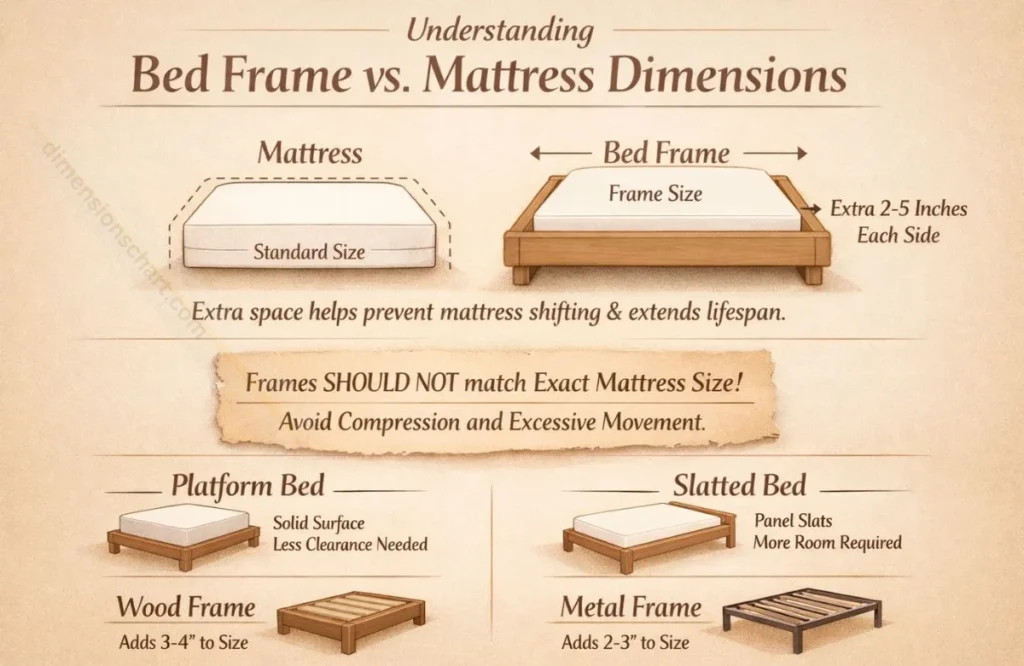
Why are bed frames bigger than mattresses? The extra 2-5 inches on each side serves critical purposes that protect your investment.
The frame’s added width prevents your mattress from shifting during sleep. This stability extends mattress lifespan and maintains proper support alignment.
Platform bed frames with solid surfaces need less clearance. Panel bed frames with slats require slightly more space to accommodate mattress edges properly.
Wood frames typically add 3-4 inches to dimensions. Metal frames often measure closer to 2-3 inches larger due to their thinner construction.
How to Choose the Right Bed Frame Size for Your Space
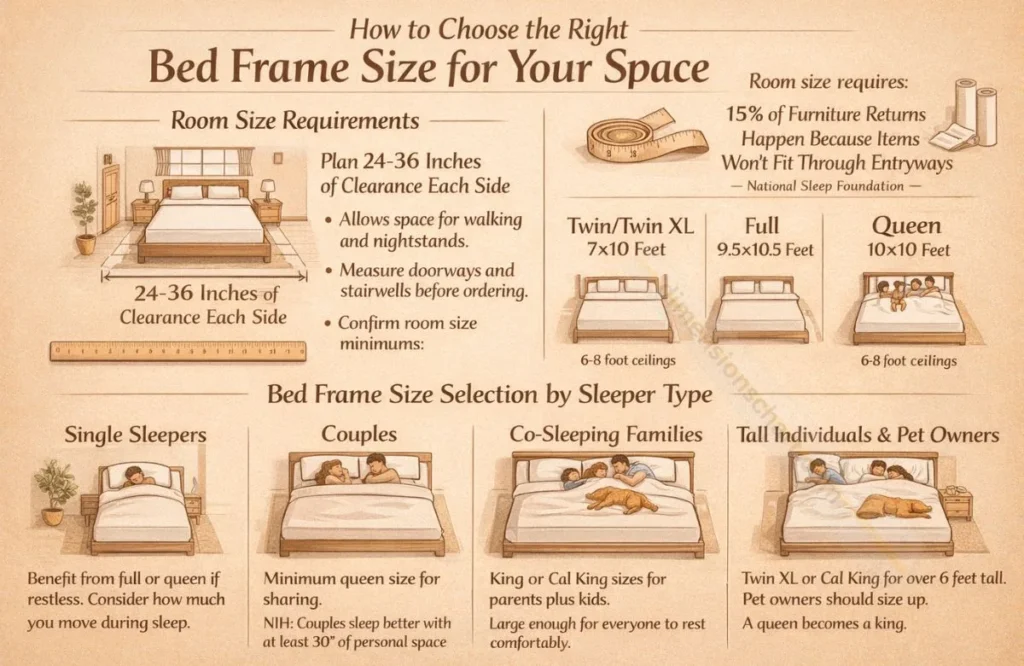
Room dimensions matter just as much as bed size when selecting your frame. A king bed might fit physically, but will you have space to walk around it?
Plan for at least 24-36 inches of clearance on each side of your bed. This walkway space allows comfortable movement and room for nightstands.
Measure your doorways and stairwells before ordering. The National Sleep Foundation reports that 15% of furniture returns happen because items won’t fit through entryways.
Minimum room sizes for each bed frame dimension:
- Twin/Twin XL: 7×10 feet
- Full: 9.5×10.5 feet
- Queen: 10×10 feet
- King/Cal King: 12×12 feet
Consider ceiling height for four-poster or canopy frames. These styles need at least 8-foot ceilings to avoid a cramped feeling.
Bed Frame Size Selection by Sleeper Type
Single sleepers should consider how much they move during sleep. Restless sleepers benefit from full or queen frames even when sleeping alone.
Couples sharing a bed need minimum queen dimensions. Sleep research from the National Institutes of Health shows couples sleep better with at least 30 inches of personal space each.
Co-sleeping families require king or California king sizes. These larger frames accommodate parents plus one or two children comfortably.
Tall individuals over 6 feet should choose Twin XL or California King options. Standard length frames leave less than 6 inches of space beyond head and feet.
Pet owners who share beds often size up one level. A queen becomes a king, a full becomes a queen, ensuring everyone has adequate space.
Popular Bed Frame Styles and Their Dimensions
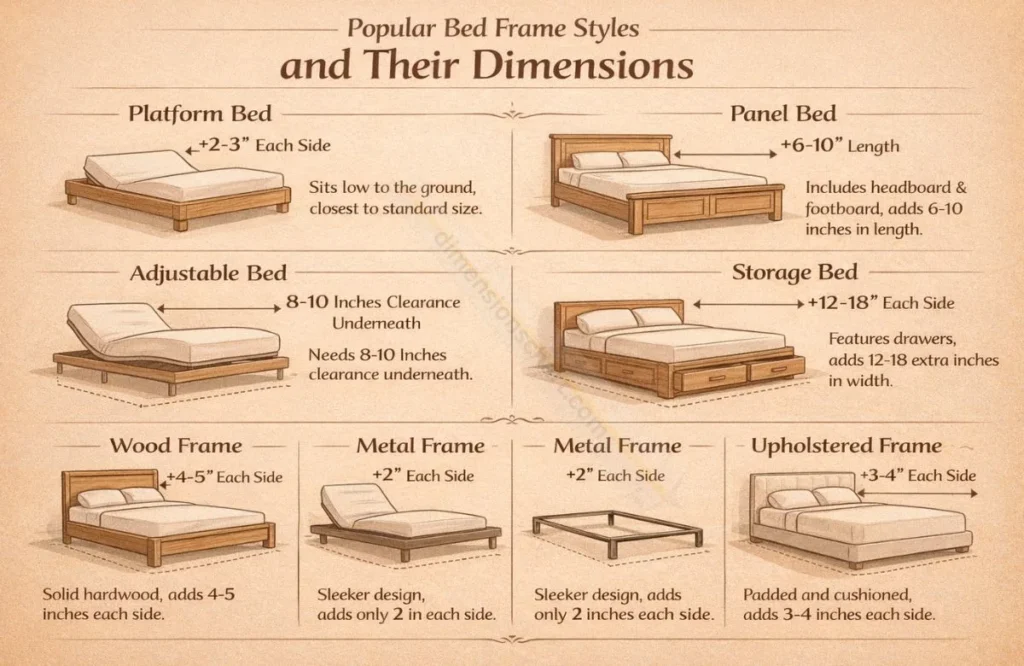
Platform bed frames sit low to the ground and don’t require box springs. Their dimensions stay closest to standard measurements, adding just 2-3 inches per side.
Panel bed frames include headboards and footboards. These decorative elements can add 6-10 inches to overall length depending on design thickness.
Adjustable bed frames match standard dimensions but need clearance underneath for mechanical components. Allow 8-10 inches of floor space beneath the mattress surface.
Storage bed frames with drawers extend outward 12-18 inches beyond standard dimensions. Factor this extra width into your room layout planning.
Wood bed frames tend to have thicker construction than metal alternatives. Solid hardwood frames may measure 4-5 inches larger than listed mattress dimensions.
Metal frames offer sleeker profiles with minimal size additions. Their thin construction typically adds only 2 inches to width and length measurements.
Upholstered frames with padded edges add 3-4 inches per side. The fabric and cushioning create a wider footprint than basic platform designs.
Conclusion
Bed frame dimensions directly impact your sleep quality and bedroom functionality. Choosing the right size starts with accurate measurements of both your mattress and available room space.
Remember that frames add 2-5 inches to mattress dimensions for proper support. Always verify your doorways can accommodate delivery before purchasing larger sizes like kings or California kings.
Use this bed frame dimensions chart as your reference guide when shopping. Match your frame to your mattress size, confirm room clearances, and you’ll create the perfect sleep sanctuary.
FAQs
What are the dimensions for bed frames?
Standard bed frame dimensions range from 40-43” × 77-80” for twin sizes up to 78-81” × 82-85” for king sizes. Bed frames measure 2-5 inches larger than their corresponding mattress dimensions to provide proper support and prevent shifting.
The extra space accommodates mattress edges securely. This sizing standard applies across most manufacturers, though decorative frames with headboards may extend several additional inches.
What is the order of bed sizes from smallest to largest?
Bed sizes from smallest to largest follow this sequence: Twin (38″ × 75“), Twin XL (38″ × 80“), Full (54″ × 75“), Queen (60″ × 80“), California King (72″ × 84“), and King (76″ × 80“).
Note that California King beds are longer but narrower than standard kings. Surface area makes King the largest overall, but Cal King wins for length.
How much bigger should a bed frame be than the mattress?
Bed frames should measure 2-5 inches larger than your mattress on each side. This clearance ensures proper support without compression or gaps that allow movement.
Platform frames need less clearance (2-3 inches). Panel frames with thicker construction require closer to 4-5 inches of additional space per side for optimal fit.
Is 60×80 a full size bed?
No, 60″ × 80″ dimensions indicate a queen size mattress, not a full size bed. A full size (also called double) measures 54″ × 75″, making it 6 inches narrower and 5 inches shorter.
The queen size bed offers 21% more sleeping surface than a full. This extra space makes queens far more comfortable for couples or individuals who move during sleep.

Burhan Ali is the founder and author of DimensionsChart.com, providing accurate size charts, measurements, and guides for smarter buying decisions.