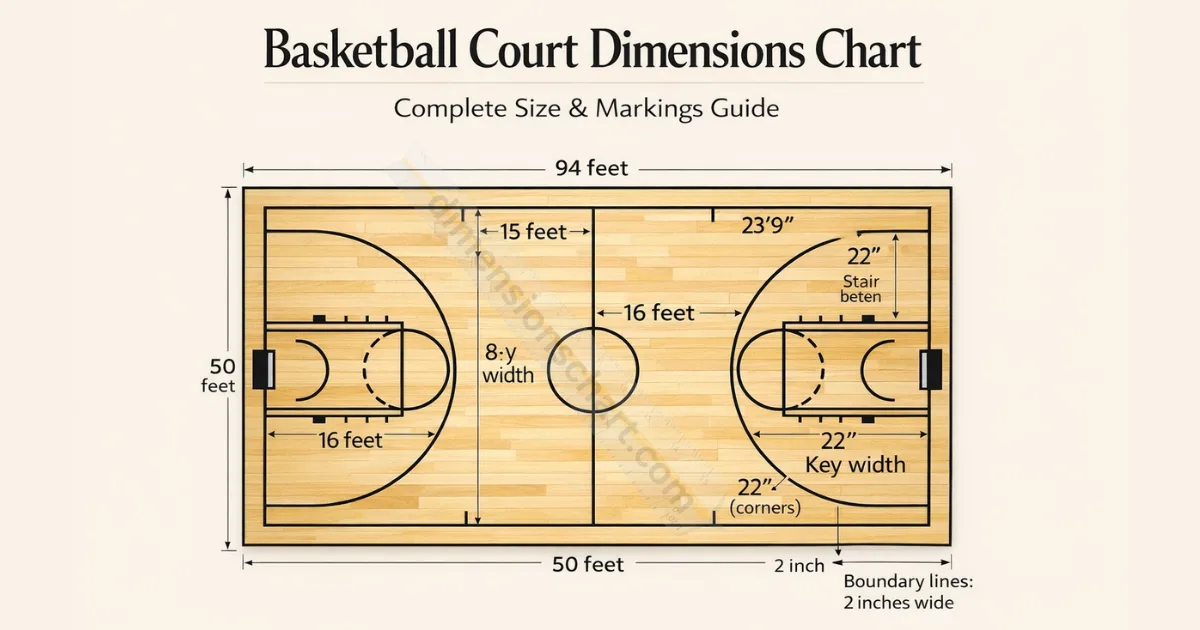
Whether you’re building a backyard court, coaching a team, or just a curious fan — knowing the exact basketball court dimensions matters more than most people think.
From the NBA regulation court size to your local high school gym, every measurement has a purpose. This guide breaks it all down — clearly, quickly, and completely.
Standard Basketball Court Dimensions by Level of Play
Not all courts are the same size. Court dimensions change depending on whether you’re playing in the NBA, college, or high school. Each level follows its own official ruleset.
Understanding these differences helps players, coaches, and builders make the right decisions — no guesswork needed.
| Court Type | Length | Width | Total Area | 3-Point Line |
|---|---|---|---|---|
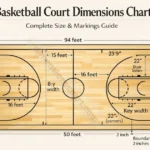
| NBA Professional | 94 ft | 50 ft | 4,700 sq ft | 23’9″ (22′ corners) |
| NCAA College | 94 ft | 50 ft | 4,700 sq ft | 22’1.75″ |
| High School (NFHS) | 84 ft | 50 ft | 4,200 sq ft | 19’9″ |
| FIBA International | 91.9 ft | 49.2 ft | 4,520 sq ft | 22’1.75″ |
| Junior High | 74 ft | 42 ft | 3,108 sq ft | 19’9″ |
| Half Court | 47 ft | 50 ft | 2,350 sq ft | Varies |
NBA Court
Hardwood maple flooring
Boundary lines: 2 inches wide
NCAA Court
Designed for college-level play
High School Court
Governed by NFHS
FIBA International Court
(91.9 ft × 49.2 ft)
Minimum ceiling: 7 meters
NBA Basketball Court Size
An NBA basketball court measures 94 feet long by 50 feet wide, covering 4,700 square feet of playing space. All NBA arenas use polished maple hardwood flooring by league mandate.
The boundary lines — sidelines and baselines — are exactly 2 inches wide. A mandatory clearance zone surrounds the court for player safety.
NCAA College Basketball Court Dimensions
NCAA courts match the NBA at 94 by 50 feet. The key difference is the three-point line, which sits at 22 feet 1.75 inches — slightly closer than the NBA arc.
This shorter arc encourages more perimeter shooting and suits the skill level of college athletes still developing their range.
High School Basketball Court Dimensions
High school courts measure 84 feet by 50 feet, governed by the National Federation of State High School Associations (NFHS). That’s 10 feet shorter than a pro court.
The reduced length fits standard school gymnasiums while keeping the game fast and competitive. Junior high courts shrink further to 74 by 42 feet for younger players.
FIBA International Basketball Court Size
FIBA courts measure 28 meters (91.9 feet) long by 15 meters (49.2 feet) wide. This is the standard for the Olympics, FIBA World Cup, and international club play.
The FIBA three-point line sits at 6.75 meters (22’1.75″), identical to the NCAA. Courts must also have a minimum ceiling height of 7 meters (23 feet).
Basketball Court Markings Explained
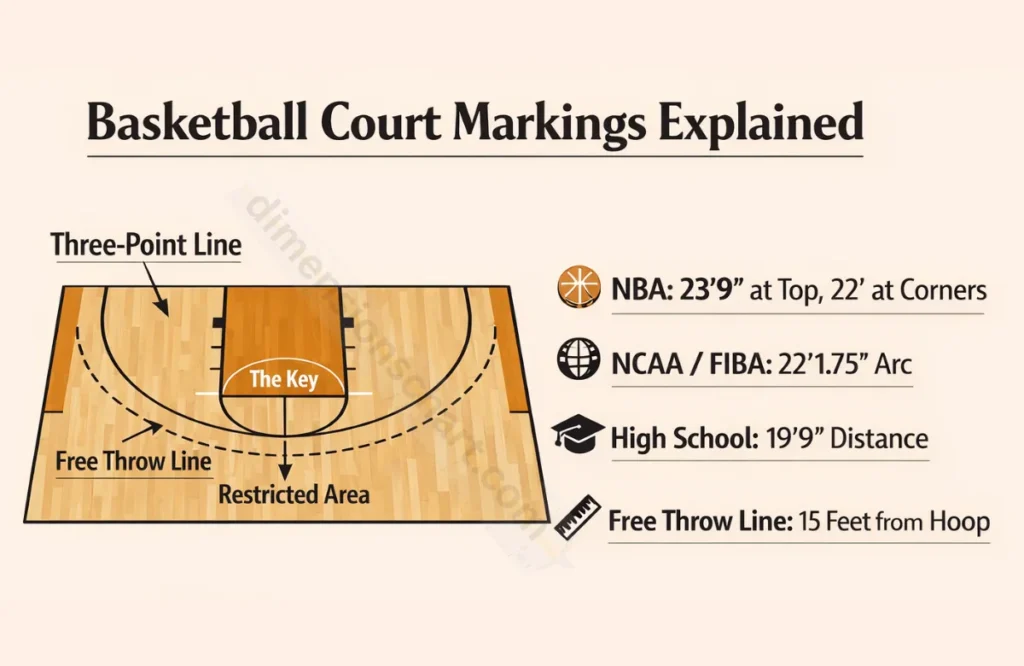
Every line on a basketball court has a specific role. These court markings control player positioning, scoring rules, and game flow. They’re not decorative — they’re functional.
All regulation lines are 2 inches wide in a contrasting color to the playing surface. Knowing each one helps players avoid violations and referees make accurate calls.
Three-Point Line Distances by Level
The NBA three-point arc extends 23 feet 9 inches from the basket at the top, but narrows to 22 feet at the corners due to court width limits.
High school players shoot from 19 feet 9 inches — a noticeably shorter distance. The NCAA and FIBA arcs both sit at 22’1.75″, leveling the playing field for international competition.
Free Throw Line, Key & Restricted Area
The free throw line sits exactly 15 feet from the backboard at every level — from youth leagues to the NBA. This is one of the few measurements that never changes.
The key (paint area) measures 16 feet wide in the NBA and high school. The restricted arc under the basket extends 4 feet from the rim center, where charging fouls cannot be called against defenders.
| Court Marking | NBA | NCAA | High School | FIBA |
|---|---|---|---|---|
| Free Throw Line | 15 ft | 15 ft | 15 ft | 15 ft (4.57m) |
| Three-Point Line (Top) | 23’9″ | 22’1.75″ | 19’9″ | 22’1.75″ |
| Three-Point (Corners) | 22 ft | 22’1.75″ | 19’9″ | 21’8″ |
| Key / Paint Width | 16 ft | 12 ft | 16 ft | 16 ft |
| Center Circle Diameter | 12 ft | 12 ft | 12 ft | 11.8 ft |
| Restricted Area Arc | 4 ft | 4 ft | N/A | 4 ft |
| Rim Height | 10 ft | 10 ft | 10 ft | 10 ft |
Basketball Hoop & Backboard Dimensions
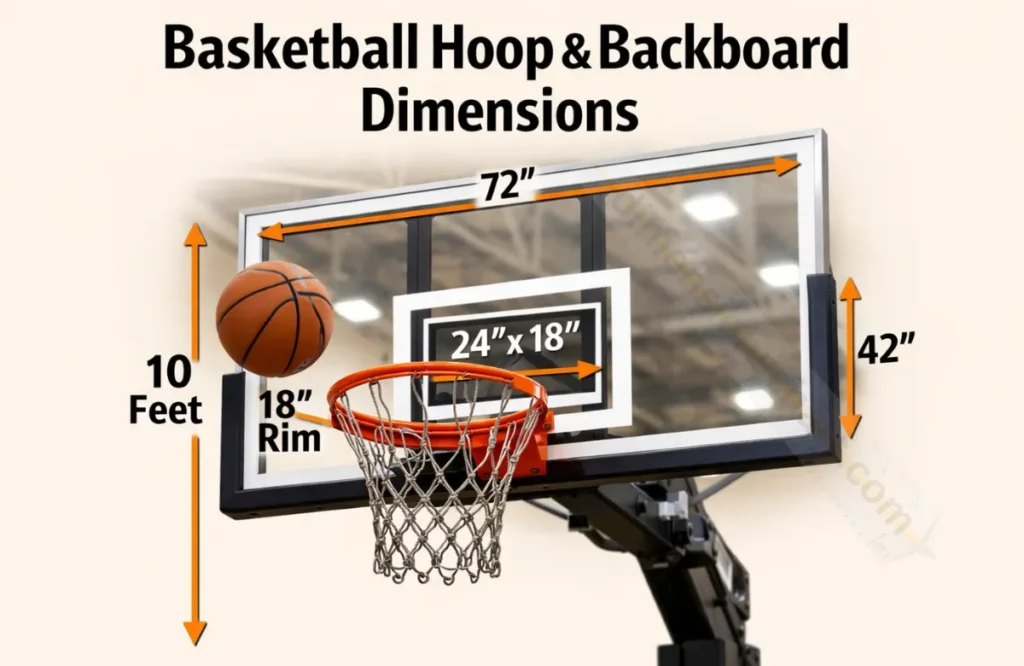
The basketball hoop is one of the most recognized standards in all of sports. It hangs at exactly 10 feet above the floor across every regulation level worldwide — no exceptions.
This height applies to NBA, NCAA, FIBA, and high school play. According to official regulations, the rim’s inside diameter is 18 inches, which is just large enough to fit two basketballs side-by-side.
The official backboard measures 72 inches wide by 42 inches tall (6 feet by 3.5 feet). Inside, a smaller inner rectangle of 24 inches by 18 inches serves as the aiming target for bank shots.
NBA and college rims feature breakaway mechanisms that flex under dunking pressure to protect the backboard and reduce injury risk. Outdoor courts often use chain nets instead of nylon for durability in all weather conditions.
| Equipment | Measurement | Notes |
|---|---|---|
| Rim Height | 10 feet (3.05m) | Universal — all levels |
| Rim Diameter (inside) | 18 inches (45.7cm) | Official regulation size |
| Backboard Width | 72 inches (1.83m) | 6 feet wide |
| Backboard Height | 42 inches (1.07m) | 3.5 feet tall |
| Inner Rectangle | 24″ x 18″ | Bank shot target box |
| Rim to Backboard | 6 inches | Measured from board face |
| Net Length | 15–18 inches | White nylon standard |
Half Court & Outdoor Basketball Court Dimensions
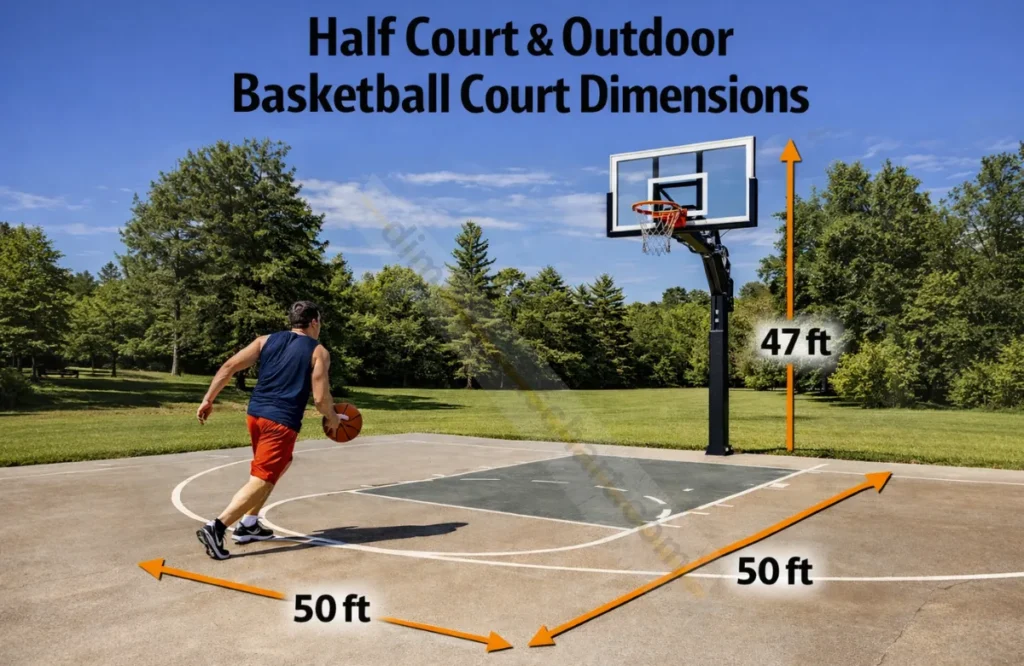
A half court basketball setup uses roughly 47 feet by 50 feet of space — exactly half of a full NBA court. It’s perfect for 3-on-3, shooting drills, and recreational play in smaller spaces.
Half courts are popular in driveways, parks, and school playgrounds. The three-point line distance adapts to whatever arc fits the space available.
For a backyard basketball court, a minimum of 30 feet by 30 feet supports basic skill work, but 40 feet by 50 feet is the sweet spot for real gameplay.
Outdoor courts use concrete or asphalt for long-term durability. Both materials handle weather exposure well. Asphalt is more cost-effective; concrete offers a harder, more consistent bounce surface.
| Space Available | Best Use | Recommended Setup |
|---|---|---|
| 20 × 30 ft | Shooting & dribbling drills | Single hoop, no lines |
| 30 × 30 ft | 1-on-1 games, skill work | Single hoop, key area |
| 40 × 50 ft | Half-court games (3v3) | Full half court + arc |
| 47 × 50 ft | Regulation half court | Official FIBA half court |
| 94 × 50 ft | Full regulation games | Official full court |
Conclusion
Every measurement on a basketball court — from the 94-foot NBA length to the 4-foot restricted arc — exists for a reason. These standards protect players, ensure fairness, and shape how the game is played.
Whether you’re planning a court build, coaching a youth team, or settling a debate, this guide gives you the exact numbers you need. Measure right, play right.
FAQs
What are the dimensions of a basketball court?
A standard NBA and NCAA court measures 94 feet long by 50 feet wide (4,700 sq ft). High school courts are 84 by 50 feet. FIBA courts measure 91.9 by 49.2 feet. The rim height is 10 feet and the free throw line is 15 feet from the backboard at every level.
Is 30×30 big enough for a basketball court?
A 30×30 space works for shooting practice and one-on-one play, but it’s too small for real games. For proper half-court gameplay, aim for at least 40 by 50 feet. A 30×30 area equals just 900 square feet — well below regulation size.
Is a size 7 basketball full size?
Yes. A size 7 basketball is the official full-size ball used in the NBA and men’s NCAA play. It has a circumference of 29.5 inches and weighs around 22 oz. Women’s leagues use a size 6 (28.5 inches). Size 7 is standard for players aged 15 and up.
How far is the 3 point line from the baseline?
The NBA corner three-point shot is taken 22 feet from the basket, which places it closest to the baseline. In FIBA and NCAA play, the corner distance is 21 feet 8 inches. High school corner threes sit at the same 19’9″ arc distance as the rest of the line.
Is 21 feet a 3 pointer?
It depends on the level. 21 feet qualifies as a three-pointer in high school (arc is 19’9″) but not in the NBA or NCAA. NBA minimum is 22 feet (corners). So in pro or college play, a shot from 21 feet counts as a two-pointer.
Is the NBA hoop 12 feet?
No. The NBA hoop is exactly 10 feet high — not 12. This is a common misconception. The 10-foot standard applies universally across NBA, NCAA, FIBA, and high school. NBA players’ elite athleticism makes the hoop appear higher than it actually is.
More Dimensions: Baseball Field Dimensions Chart

Burhan Ali is the founder and author of DimensionsChart.com, providing accurate size charts, measurements, and guides for smarter buying decisions.