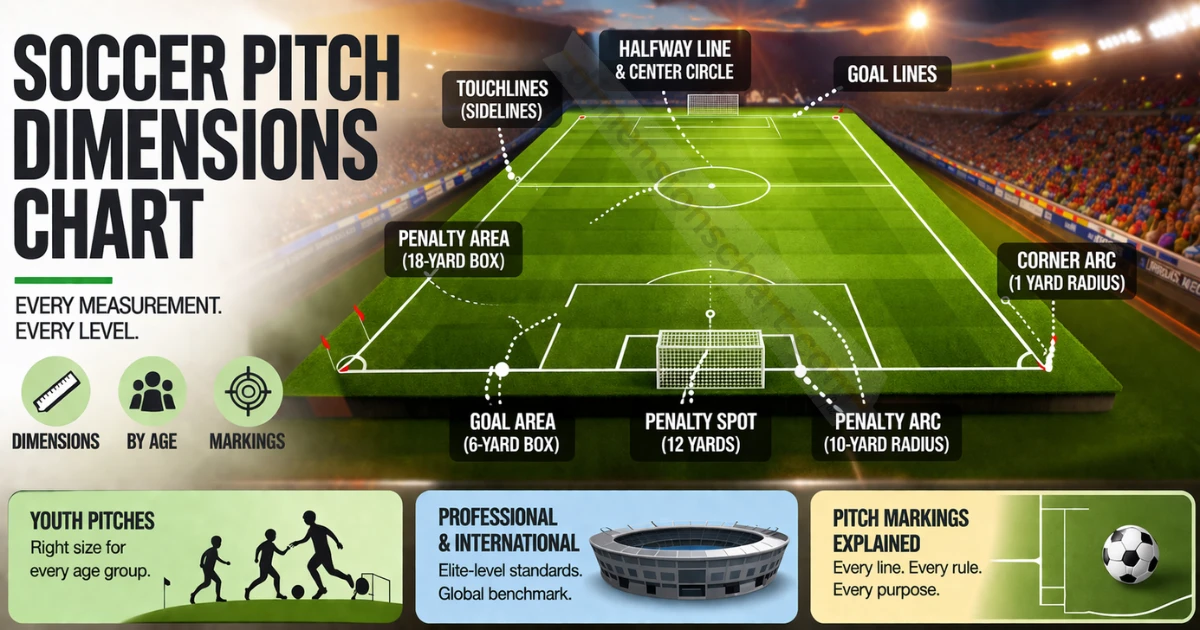
Not every soccer field is the same size. From a youth soccer pitch in a local park to a FIFA World Cup stadium, dimensions change based on age, competition level, and governing body rules.
This soccer pitch dimensions chart covers everything — youth fields, professional sizes, pitch markings, and international standards — all in one easy reference guide.
Standard Soccer Pitch Dimensions Chart (Yards & Meters)
FIFA sets the global rules for soccer field dimensions. For general matches, the allowed range is 100–130 yards long and 50–100 yards wide (90–120 m x 45–90 m). Most professional games use the tighter international range.
The most widely used standard soccer pitch size at the pro level is 105 x 68 meters (approximately 115 x 74 yards) — used at the FIFA World Cup, UEFA Champions League, and most top-tier leagues.
| Standard | Length (Yards) | Width (Yards) | Length (Meters) | Width (Meters) |
|---|---|---|---|---|
| FIFA General | 100–130 | 50–100 | 90–120 | 45–90 |
| FIFA International | 110–120 | 70–80 | 100–110 | 64–75 |
| UEFA Standard | ~115 | ~74 | 105 | 68 |
| MLS (Avg) | 110–120 | 70–78 | 100–110 | 64–71 |
| High School | 110–120 | 65–75 | 100–110 | 59–68 |
| NCAA College | 115–120 | 70–75 | 105–110 | 64–68 |
FIFA allows flexible pitch sizes so different stadiums — from local clubs to professional venues — can host matches without needing identical field dimensions.
Youth Soccer Pitch Dimensions Chart by Age Group
FIFA and the US Youth Soccer Association (USSF) both agree — younger players need smaller fields. Smaller pitches mean more touches, more involvement, and faster development for young athletes.
As players grow older, pitch size increases gradually until they reach the full 11-a-side format at age 13 and above.
| Age Group | Format | Length (Yards) | Width (Yards) | Goal Size | Ball Size |
|---|---|---|---|---|---|
| Under 6 | 3v3 / 4v4 | 25–35 | 15–25 | 6 x 4 ft | Size 3 |
| Under 7–8 | 4v4 / 5v5 | 25–35 | 15–25 | 12 x 6 ft | Size 3 |
| Under 9–10 | 6v6 / 7v7 | 55–65 | 35–45 | 12 x 6 ft | Size 3 |
| Under 11–12 | 8v8 / 9v9 | 70–80 | 45–55 | 16 x 7 ft | Size 4 |
| Under 13–14 | 11v11 | 90–100 | 55–65 | 21 x 7 ft | Size 4 |
| Under 15–16 | 11v11 | 100–110 | 60–70 | 24 x 8 ft | Size 5 |
| Under 17–18+ | 11v11 | 110–130 | 65–100 | 24 x 8 ft | Size 5 |
At U13, players move to the full 11-a-side format. This is the biggest jump in youth soccer — with a larger pitch and more tactical complexity. This step helps players develop better positioning and game awareness.
Professional & International Soccer Pitch Dimensions
At the elite level, pitch sizes are tightly controlled. UEFA mandates exactly 105 x 68 meters for all Champions League and Europa League venues — no exceptions.
FIFA World Cup pitches follow the same standard. The MLS allows slight variation by stadium, but most clubs stay close to the 105 x 68 m benchmark.
| Competition / Stadium | Yards (Length × Width) | Meters (Length x Width) |
|---|---|---|
| FIFA World Cup | 115 x 74 | 105 x 68 |
| UEFA Champions League | 115 x 74 | 105 x 68 |
| Premier League (Avg.) | ~115 x 74 | ~105 x 68 |
| Man City – Etihad | 116 x 77 | 106 x 70 |
| Liverpool – Anfield | 110 x 75 | 101 x 69 |
| MLS – Atlanta United | 115 x 75 | 105 x 68 |
| Olympic Soccer | 110–120 x 70–80 | 100–110 x 64–75 |
Some clubs deliberately adjust pitch width based on playing style. Possession-based teams prefer wider fields, while defensive teams often choose narrower pitches to reduce space and limit attacking movement.
Every line on a soccer pitch has a purpose and a precise measurement. All field lines must be exactly 5 inches (12 cm) wide, according to IFAB (International Football Association Board) rules.
Conclusion
Understanding the soccer pitch dimensions chart helps coaches plan training, helps parents choose the right age-group leagues, and helps facility managers build the right-sized fields. From U6 youth pitches to FIFA World Cup stadiums, every measurement has a reason behind it.
Bookmark this guide as your go-to reference for official soccer field dimensions — whether you’re in a local league or building toward professional standards.
FAQ’s
What size is a standard soccer pitch?
A standard soccer pitch measures 100–130 yards long and 50–100 yards wide. For professional matches, the recommended size narrows to 105 x 68 meters (115 x 74 yards), which is the global benchmark used in the FIFA World Cup and UEFA competitions.
What is the size of a Premier League pitch?
Premier League pitches vary by club but average around 105 x 68 meters. For example, Manchester City’s Etihad Stadium measures 106 x 70 m, while Liverpool’s Anfield is approximately 101 x 69 m. Each club chooses its dimensions within the FIFA-permitted range.
Are all pitches on FIFA the same size?
No. FIFA sets an allowable range — not a fixed size. Domestic pitches can be 90–120 m long and 45–90 m wide. International matches use a tighter range of 100–110 m x 64–75 m. Clubs choose their exact dimensions within these limits.
What size is a FIFA Quality Pro pitch?
FIFA Quality Pro is a ball certification, not a pitch standard. However, testing conditions are based on a 105 x 68 meter pitch — the FIFA-recommended size for elite competition. This is the same dimension used at the World Cup and Champions League.
How big is the UEFA pitch?
UEFA mandates a fixed 105 x 68 meters (approximately 115 x 74 yards) for all Champions League and Europa League matches. This ensures every competitive match is played on an identical surface, regardless of the host country or stadium.
Which football stadium has 150,000 capacity?
No active soccer stadium holds 150,000 people. The Rungrado 1st of May Stadium in North Korea has a reported capacity of around 114,000. The largest venue regularly used for major sports is Narendra Modi Stadium in India (~132,000), which primarily hosts cricket.

Burhan Ali is the founder and author of DimensionsChart.com, providing accurate size charts, measurements, and guides for smarter buying decisions.