Picking the wrong garage door size is a costly mistake. It can mean re-framing, delayed installation, and hundreds in extra labor costs.
This garage door dimensions chart gives you every standard size — from single-car to RV — so you buy right the first time.
Standard Garage Door Dimensions Chart (Single & Double)
Below is a complete garage door size chart covering the most common residential and specialty sizes used across the US.
Standard Garage Door Dimensions Chart
| Door Type | Width | Height | Best For | Notes |
|---|---|---|---|---|
| Single Car | 8 ft | 7 ft | Compact cars, sedans | Most affordable option |
| Single Car | 9 ft | 7 ft | SUVs, trucks | Popular in new US builds |
| Single Car | 10 ft | 7 ft | Full-size trucks, vans | Max single-door width |
| Double Car | 14 ft | 7 ft | Tighter two-car layouts | Less common |
| Double Car | 16 ft | 7 ft | Two cars side by side | US national standard |
| Double Car | 18 ft | 7–8 ft | Large SUVs, trucks | Extra maneuvering room |
| 1.5 Car | 12–14 ft | 7 ft | One car + storage | Good mid-range option |
| Tall / 8 ft Height | 8–18 ft | 8 ft | SUVs with roof racks | Increasingly common |
| RV / Oversized | 12–16 ft | 12–14 ft | Motorhomes, campers | Special order required |
| Commercial | 10–20+ ft | 10–14 ft | Service bays, loading docks | Non-residential sizing |
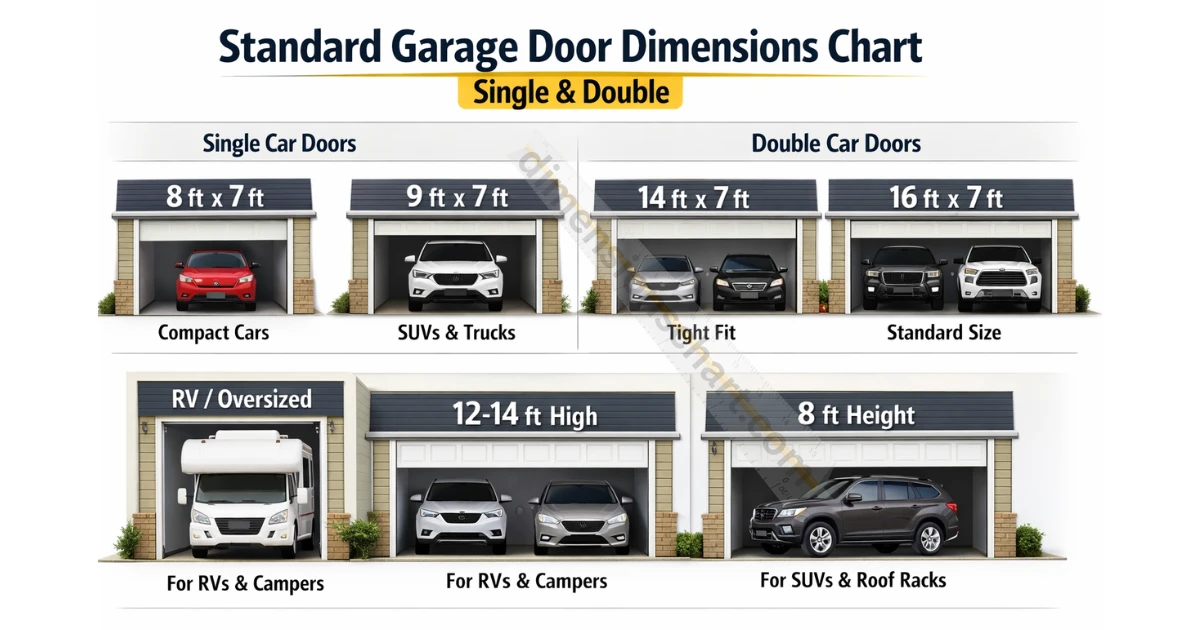
8 ft × 7 ft is the classic size for compact cars and sedans.
9 ft × 7 ft provides more clearance for SUVs and modern vehicles.
16 ft × 7 ft is the national standard for two-car garages in the US.
8 ft or taller doors are ideal for roof racks, trucks, and large SUVs.
Standard Single Car Garage Door Dimensions
The most common single garage door size is 8 ft wide × 7 ft tall. It fits most compact cars and sedans with ease.
Newer builds favor 9×7 ft doors for the extra clearance. If you drive a full-size truck or van, step up to 10×7 ft — the widest standard single-door option.
Standard Double Car Garage Door Dimensions
The standard double garage door size is 16 ft wide × 7 ft tall. This is the national baseline for two-car garages in the US.
Need room for two large SUVs or trucks? Go with 18 ft wide. Tighter layouts can use a 14 ft door, though parking precision is required.
Standard Garage Door Height Variations
The standard garage door height is 7 feet — this fits roughly 80% of US residential garages. Most passenger vehicles clear it with room to spare.
An 8 ft tall door works well for SUVs with roof racks or bike mounts. Heights of 9–10 ft are available for lifted trucks and motorhomes but usually require a special order.
Garage Door Size Chart by Garage Type
One-Car Garage Door Size Chart
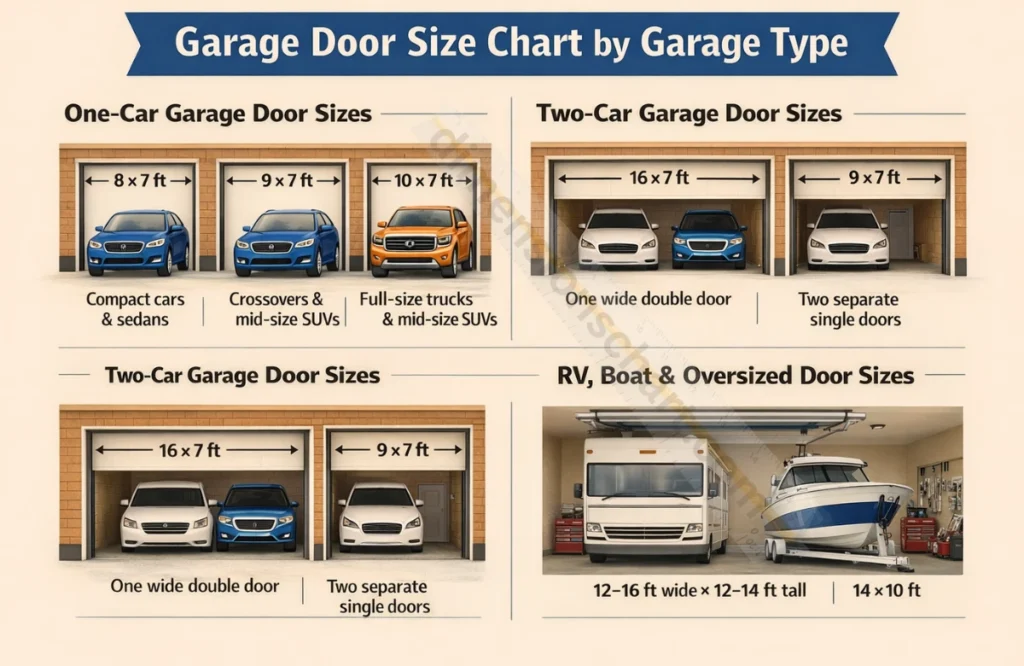
A one-car garage door ranges from 8–10 ft wide and 7–8 ft tall. The right pick depends on your vehicle.
8×7 ft → compact cars & sedans | 9×7 ft → crossovers & mid-size SUVs | 10×7 ft → full-size trucks & vans
Two-Car Garage Door Size Chart
You have two options for a two-car garage: one wide double door or two separate single doors. One double door (16×7 ft) is cheaper to install and easier to operate.
Two separate 9×7 ft single doors give more flexibility — each car operates independently. It’s a popular choice in newer suburban US homes.
RV, Boat & Oversized Garage Door Sizes
An RV garage door typically measures 12–16 ft wide × 12–14 ft tall. Standard 7 ft doors simply won’t clear a motorhome or camper.
Boat storage and workshop garages often need 14 ft wide × 10 ft tall openings. These are non-standard and require a custom or special-order door.
How to Measure for the Right Garage Door Size
Measuring Width and Height
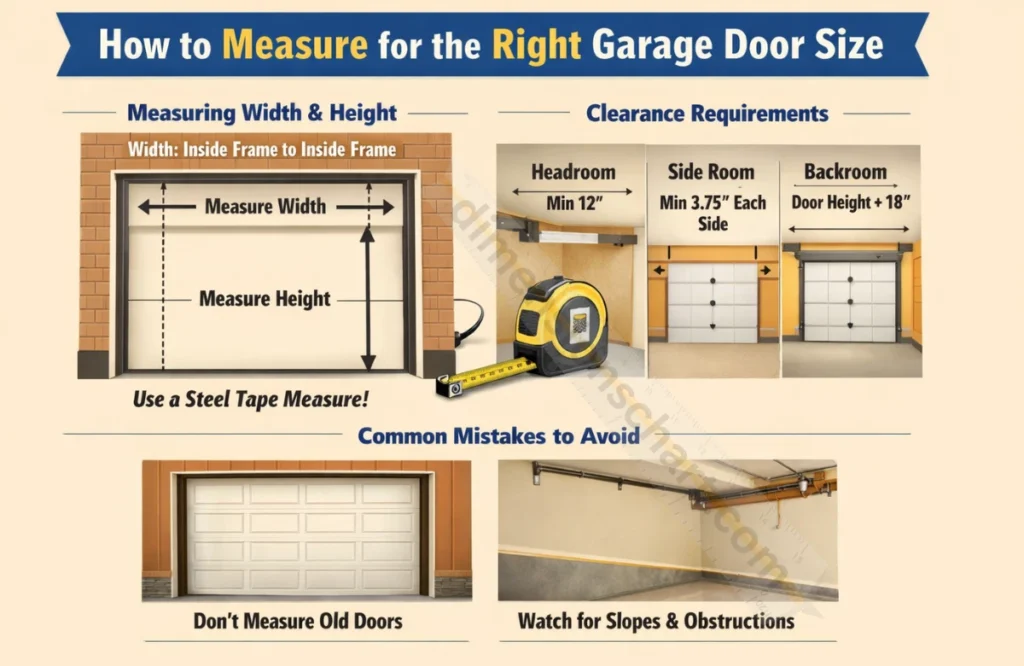
Measure the rough opening width from inside edge to inside edge of the door frame. Always use a steel tape — cloth tapes stretch and give inaccurate readings.
For height, measure from the floor to the bottom of the header. Take three readings — left, center, right — and use the smallest number. Floors often slope for drainage.
Headroom, Side Room & Backroom Explained
Headroom: Minimum 10 inches for extension springs; 12 inches for torsion springs. This is the space above the door to the ceiling.
Side room: At least 3.75–4 inches on each side for track mounting. Backroom: Door height plus 18 inches minimum — measured from the opening to the back wall.
Common Measuring Mistakes to Avoid
Never measure the old door — measure the actual opening. Old doors are sometimes the wrong size to begin with.
Don’t ignore floor slope or ceiling obstructions. Both affect your headroom clearance and can prevent a standard track system from fitting.
Standard vs. Custom Garage Door Sizes — Which Do You Need?
Benefits of Sticking With Standard Sizes
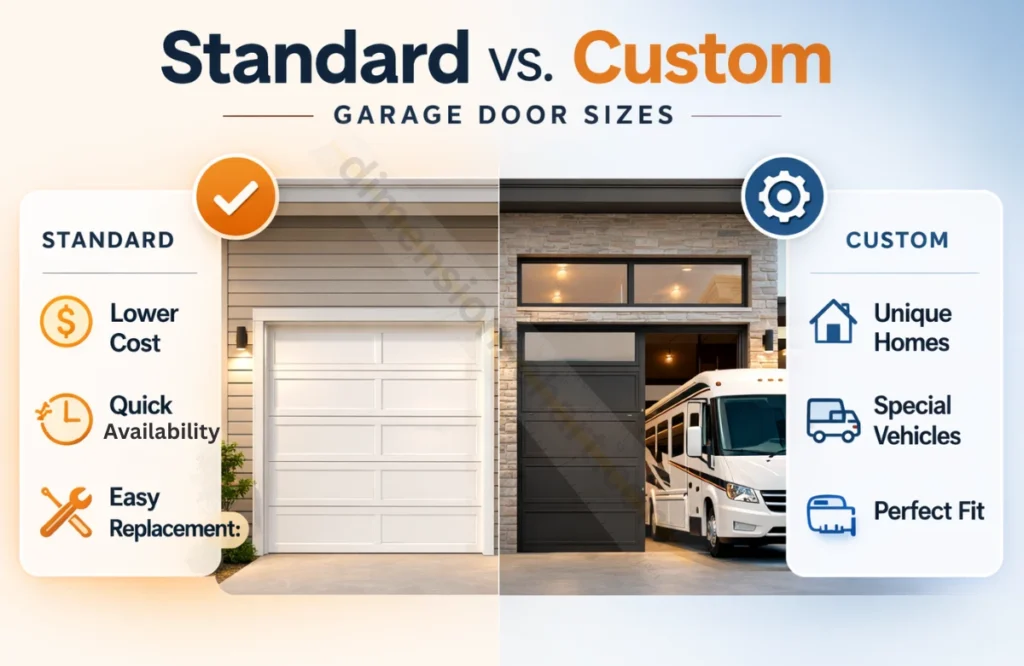
Standard garage door sizes cost 30–50% less than custom options, according to industry estimates. They’re stocked by most US dealers and ship fast.
Standard sizing also means compatible hardware — openers, springs, and tracks are all designed around 8×7, 9×7, and 16×7 ft dimensions. Replacement parts are easy to source.
When Custom Garage Door Dimensions Make Sense
Custom doors are the right call for older homes with non-standard framing, unique architectural designs, or specialty vehicles like lifted trucks and Class A motorhomes.
The tradeoffs are real — custom doors cost more, take longer to manufacture, and require precise professional measurements. But they’re sometimes the only option that fits and performs correctly.
Garage Door Size and Opener Horsepower Guide
Matching Door Size to the Right Opener HP
A ¾ HP garage door opener handles single doors up to 10 ft wide without issue. It’s the standard choice for most single-car residential garages across the US.
Any double door, insulated door, or door exceeding 200 lbs needs a 1¼ HP motor. Running an undersized opener causes premature motor failure and unreliable daily operation.
Conclusion
Getting your garage door dimensions right saves time, money, and installation headaches. Use this garage door dimensions chart as your reference before measuring, ordering, or replacing.
Stick to standard sizes where possible — they’re cheaper, faster to ship, and easier to service. When in doubt, consult a certified local dealer for an on-site measurement.
FAQ’s
How wide is a 1.5 garage door?
A 1.5-car garage door typically measures 12 to 14 feet wide by 7 feet tall. It bridges the gap between a standard single and double door. It’s a great choice for one car plus a dedicated workspace or storage area on the side.
Is a 7 foot garage door actually 7 feet?
Yes — a 7 ft garage door is a true 7 feet in height. The rough opening in the framing is built to match the door exactly. Always measure the rough opening height — from the floor to the bottom of the header — before ordering.
Can you get a 20 ft wide garage door?
Yes, 20 ft wide garage doors are available as special-order products. They’re rare in residential settings and more common in commercial garages, workshops, and multi-vehicle storage facilities. Professional installation is required.
What is the average size 2 car garage door?
The average two-car garage door size is 16 ft wide × 7 ft tall. This is the standard across most US suburban homes. Some homeowners choose 18 ft widths when parking full-size trucks or large SUVs side by side.
What is a standard garage size?
A standard two-car garage interior measures approximately 20 ft wide × 20 ft deep. A single-car garage typically runs 12 ft wide × 22 ft deep. These dimensions are designed to pair with the most common door sizes.
What is the most common size of garage door?
The most common garage door size in the US is 16×7 ft for double garages and 9×7 ft for single garages. These two sizes cover the majority of American residential builds and are available at standard pricing from virtually every manufacturer.

Burhan Ali is the founder and author of DimensionsChart.com, providing accurate size charts, measurements, and guides for smarter buying decisions.