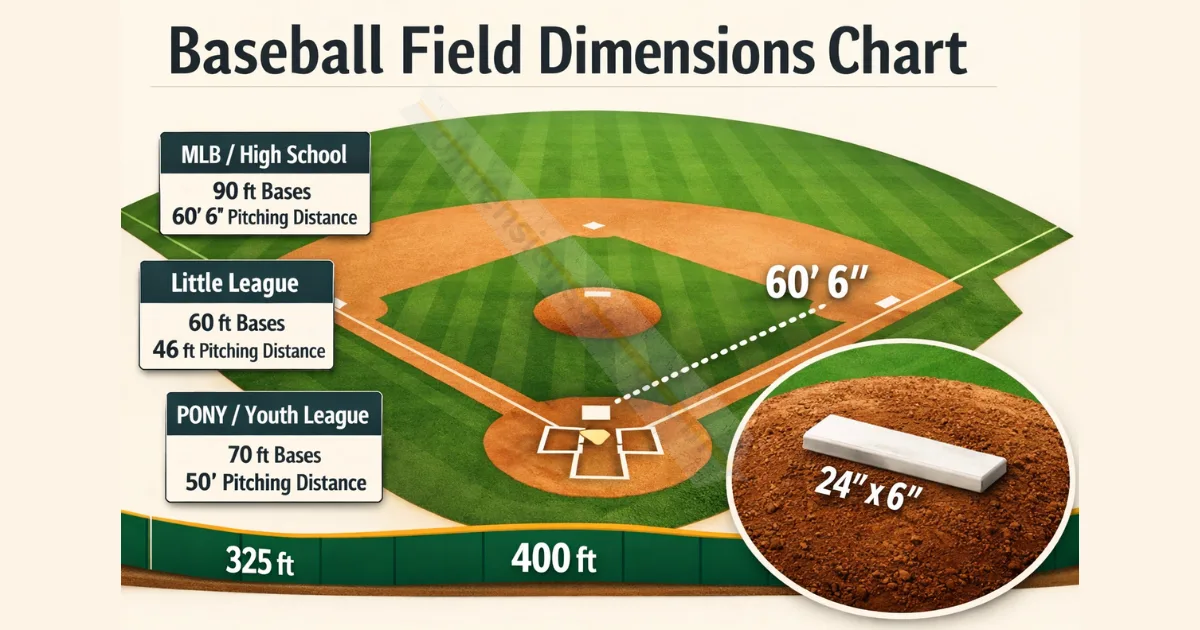
Not every baseball field looks the same. Sizes change based on the age group, league level and governing body. Getting the dimensions wrong costs teams compliance, safety, and fair play.
This guide gives you the complete baseball field dimensions chart — from MLB specifications to Little League to PONY League — all in one place.
Standard Baseball Field Dimensions Chart by Age Group and League
| League / Level | Base Path | Pitching Distance | Outfield (CF) | L/R Field |
|---|---|---|---|---|
| MLB / High School / College | 90 ft | 60 ft 6 in | 400 ft+ | 325–350 ft |
| Little League (9–12) | 60 ft | 46 ft | 200 ft+ | 200 ft+ |
| Intermediate 50/70 (11–13) | 70–90 ft | 50–60 ft 6 in | 200 ft+ | 200 ft+ |
| Junior League (12–14) | 75–90 ft | 54–60 ft 6 in | 300 ft+ | 300 ft+ |
| Senior League (13–16) | 90 ft | 60 ft 6 in | 300 ft+ | 300 ft+ |
| Middle School (7th grade) | 70 ft | 50 ft | 200 ft+ | 200 ft+ |
| Middle School (8th grade) | 80 ft | 54 ft | 300 ft+ | 300 ft+ |
MLB and High School Baseball Field Dimensions
Base Path Length
90 Feet
Pitching Distance
60 ft 6 in
Mound Height
10 Inches
Mound Diameter
18 Feet
At the professional level, Major League Baseball fields use 90-foot base paths and a pitching distance of exactly 60 feet 6 inches. High school baseball mirrors these infield specs perfectly.
The pitcher’s mound sits 10 inches high with an 18-foot diameter circle. This setup has stayed unchanged since 1893, making it one of the most enduring measurements in all of sports.
Youth Baseball Dimensions Chart (Little League & PONY League)
Little League uses 60-foot base paths and a 46-foot pitching distance for ages 9–12. This smaller layout protects young arms and builds proper mechanics.
The PONY League system scales dimensions more gradually. Below is the full PONY League baseball field size chart by division.
Youth Baseball Dimensions Chart
| PONY Division | Age Group | Diamond Size | Pitching Distance | CF Min |
|---|---|---|---|---|
| Foal / Shetland | 3–6 | 50 ft | 38 ft | 200 ft |
| Pinto | 5–8 | 60 ft | 38 ft | 200 ft |
| Mustang | 7–10 | 60 ft | 46 ft | 225 ft |
| Bronco | 9–12 | 70 ft | 50 ft | 275 ft |
| Pony | 11–14 | 80 ft | 54 ft | 315 ft |
| Colt / Palomino | 13–19 | 90 ft | 60 ft 6 in | 350 ft |
| Thorobred | 17–23 | 90 ft | 60 ft 6 in | 350 ft |
Middle School and College Baseball Field Size Chart
Middle school fields shift at 7th grade to a 70-foot diamond with a 50-foot pitching distance. By 8th grade, that grows to 80-foot bases and a 54-foot pitching distance.
College (NCAA) fields match MLB infield specs — 90-foot bases and 60 feet 6 inches from the rubber to home. The recommended outfield is 400 feet to center and 330+ feet down the foul lines.
More Post: Red Bull Can Dimensions Chart 2026
Baseball Infield Dimensions and Measurements
Every part of the infield has a purpose. From the batter’s box to the pitcher’s rubber, each measurement is defined by official rulebooks. Here is the full breakdown.
Baseball Infield Dimensions and Measurements
| Component | MLB / High School Spec | Youth (Little League) |
|---|---|---|
| Base Path | 90 ft (27.4 m) | 60 ft (18.3 m) |
| Pitching Rubber to Home Plate | 60 ft 6 in (18.4 m) | 46 ft (14 m) |
| Pitcher’s Mound Height | 10 inches | 6 inches |
| Pitcher’s Mound Diameter | 18 ft circle | 8 ft circle |
| Pitcher’s Rubber Size | 24 in × 6 in | 18 in × 4 in |
| Home Plate Width | 17 inches | 17 inches |
| Home Plate Depth | 17 inches | 17 inches |
| Base Size (each) | 18 in × 18 in | 15 in × 15 in |
| Batter’s Box (each side) | 4 ft × 6 ft | 3 ft × 6 ft |
| Catcher’s Box | 43 in wide | 43 in wide |
| Backstop Distance | 60+ ft (MLB) | 25 ft (minimum) |
| Warning Track Width | 15 ft minimum | N/A (youth) |
Base Path Distances and Diamond Size
The baseball diamond is a perfect square. At the MLB level it measures 90 feet on all sides. The distance from home plate to second base is 127 feet 3⅜ inches — calculated diagonally.
Bases were updated in 2022 from 15 inches to 18 inches square to reduce player collision risk. This change applies at the MLB and affiliated minor league levels.
Pitcher’s Mound Dimensions and Specifications
The pitcher’s mound in baseball is a raised dirt area at the center of the infield. The pitching rubber measures 24 inches long by 6 inches wide and is set exactly 60 feet 6 inches from home plate.
The mound’s peak sits 10 inches above field level and is placed 18 inches behind the center of the 18-foot diameter mound circle. Proper slope and drainage are critical for long-term mound integrity.
Home Plate, Batter’s Box, and Catcher’s Box Measurements
Home plate is a five-sided slab. The front edge spans 17 inches wide. The two sides each run 8.5 inches, with a rear point extending 12 inches.
Each batter’s box measures 4 feet wide by 6 feet long and sits 6 inches from home plate. The catcher’s box extends 43 inches wide directly behind home plate.
More Post: Kitchen Trash Can Dimensions Chart 2026
Baseball Outfield Dimensions and Fence Distances
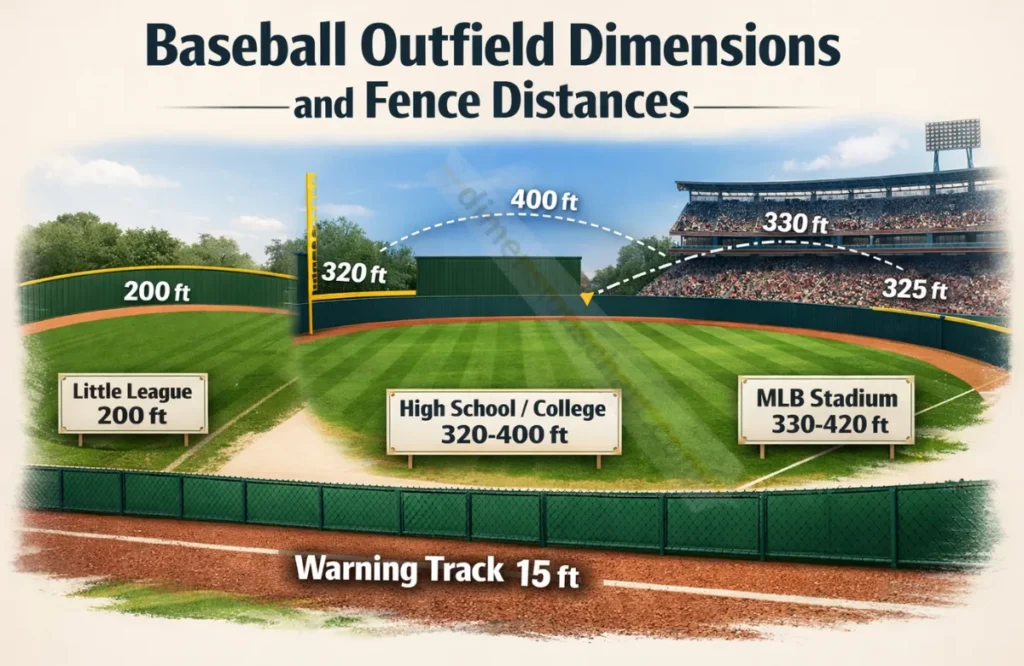
Unlike the infield, outfield dimensions vary widely — even at the MLB level. Understanding the minimums at each level is essential for field construction compliance.
Standard Outfield Fence Requirements by League Level
Little League requires a minimum of 200 feet to the outfield fence. High school mandates 300–325 feet down the foul lines. College recommends 330+ feet at minimum.
Warning tracks must extend at least 15 feet from the outfield fence. The different surface — typically crushed brick or gravel — gives fielders a tactile alert before reaching the wall.
MLB Outfield Dimensions: Park-by-Park Variations
No two MLB parks are identical in the outfield. Comerica Park in Detroit has the deepest center field at 420 feet. Fenway Park in Boston has the shallowest at just 310 feet down the left-field line.
The MLB suggested minimum is 325 feet down the foul lines and 400 feet to dead center. Most modern parks fall between these figures and around 420 feet.
Baseball Field Dimensions in Feet vs Meters
If you are building or planning a field outside the US, converting baseball field dimensions to meters is essential. The table below covers every key metric conversion you need.
| Measurement | Feet | Meters |
|---|---|---|
| Base Path (MLB) | 90 ft | 27.43 m |
| Base Path (Little League) | 60 ft | 18.29 m |
| Pitching Distance (MLB) | 60 ft 6 in | 18.44 m |
| Pitching Distance (Little League) | 46 ft | 14.02 m |
| Home-to-Second Base | 127 ft 3⅜ in | 38.79 m |
| Outfield CF (MLB) | 400+ ft | 121.9+ m |
| Outfield Foul Line (MLB min) | 325 ft | 99.06 m |
| Outfield CF (College rec.) | 400 ft | 121.9 m |
| Outfield Foul Line (High School) | 300–325 ft | 91.4–99.1 m |
| Outfield CF (Little League) | 200+ ft | 60.96+ m |
Full Baseball Field Size Conversion Chart (Feet to Meters)
The 90-foot base path converts to 27.43 meters. The iconic 60-foot 6-inch pitching distance becomes 18.44 meters — a figure now used by international leagues worldwide.
When building for international competition under organizations like the World Baseball Softball Confederation (WBSC), these metric values are the official reference.
How Field Dimensions Scale Across Age Groups
Field dimensions are not arbitrary. They scale with player development. A 7-year-old cannot safely pitch from 60 feet 6 inches. Each incremental increase in base path length prepares players for the next level of competition.
Research shows that arm injury rates drop significantly when youth players compete on properly sized fields. The Pitch Smart guidelines from MLB support age-appropriate field dimensions as a key injury prevention tool.
Baseball vs Softball Field Dimensions Chart
Baseball and softball share the same basic layout but differ sharply in field size, pitching mechanics, and ball dimensions. Here is a clear side-by-side comparison.
| Feature | Baseball (MLB) | Fastpitch Softball | Slowpitch Softball |
|---|---|---|---|
| Base Path | 90 ft | 60 ft | 60 ft |
| Pitching Distance | 60 ft 6 in | 43 ft | 50 ft |
| Pitcher’s Mound | Elevated 10 in | Flat (no mound) | Flat (no mound) |
| Outfield Fence (Center) | 400+ ft | 220+ ft | 275–300 ft |
| Outfield Fence (Foul Line) | 325+ ft | 200 ft | 275 ft |
| Infield Square Area | ~8,100 sq ft | ~3,600 sq ft | ~3,600 sq ft |
| Ball Size | 9–9.25 in circ. | 12 in circ. | 12 in circ. |
Key Infield and Outfield Size Differences
A baseball infield at 90-foot bases covers roughly 8,100 square feet. Softball’s 60-foot infield covers only about 3,600 square feet — less than half the area. This compression demands much faster reactions from infielders.
Softball originated as an indoor game in 1887. Its smaller dimensions were designed for limited gymnasium space and have remained largely consistent because the underhand pitching mechanic generates less velocity, requiring a shorter distance for competitive balance.
Pitching Distance Comparison: Baseball vs Softball
Women’s fastpitch softball pitches from 43 feet on flat ground — no mound. Men’s slowpitch increases that to 50 feet to account for the higher arc required for a legal delivery.
Baseball’s 60-foot 6-inch distance with a 10-inch elevated mound creates a very different pitch angle. Despite softball’s shorter distance, elite fastpitch pitchers can reach 70+ mph — giving batters roughly the same reaction time as MLB hitters.
More Post: Garage Door Dimensions Chart 2026
Conclusion
Every measurement on a baseball field serves a purpose — player safety, fair competition, and skill development. Whether you are building a new facility or coaching a youth team, using the right baseball field dimensions chart is non-negotiable.
From the MLB’s 90-foot diamond to Little League’s 60-foot base paths, every level has a spec designed for that age and ability. Use this guide as your go-to reference and get every measurement right the first time.
FAQ’s
What is a full-size baseball field?
A full-size baseball field features 90-foot base paths, a 60-foot 6-inch pitching distance, and outfield fences ranging from 325 to 400+ feet. This is the standard used in MLB, college, and high school baseball.
What are the dimensions of a standard baseball?
A regulation baseball measures 9 to 9.25 inches in circumference and weighs 5 to 5.25 ounces. It features a cork-rubber core, yarn winding, and white leather cover stitched with 108 red stitches.
What is the 80/20 rule in baseball?
The 80/20 rule is a scouting concept. It means a player must score an 80 grade (the highest on the 20–80 scouting scale) in at least one tool, with no grade below 20, to project as a viable MLB prospect. It guides how scouts evaluate talent.
How big is a baseball field in meters?
The standard MLB baseball field has 90-foot base paths equal to 27.43 meters and a pitching distance of 18.44 meters. The outfield foul lines start at a minimum of 99 meters with center field typically exceeding 121 meters.
What is the standard size of a baseball field?
The standard baseball field uses 90-foot bases, a 60-foot 6-inch pitching distance, and outfield fences from 325 to 400+ feet. Youth fields scale down based on age group, starting as small as 50-foot bases for Tee Ball.
What does 6 4 3 2 in baseball mean?
In baseball scoring notation, numbers represent fielding positions. 6-4-3-2 describes a play where the shortstop (6) throws to second base (4), then to first base (3), then home plate (2) — a double play sequence or attempted triple play.

Burhan Ali is the founder and author of DimensionsChart.com, providing accurate size charts, measurements, and guides for smarter buying decisions.