Do you ever pick up a can of soup and wonder exactly how big it is? Whether you’re organizing your pantry, planning a recipe, or buying in bulk — knowing the soup can dimensions chart saves time and prevents costly mistakes.
From the classic condensed soup can on every American kitchen shelf to the massive #10 food service can used in restaurants — every size has a specific diameter, height, and capacity. This guide covers them all, clearly and completely.
| Visual | Can Size Code | Can Name | Diameter (in) | Height (in) | Capacity (oz) | Common Use | Cups |
|---|---|---|---|---|---|---|---|
| 300×407 | Condensed | 3.0 in | 4.5 in | 10.5–10.75 oz | Standard condensed soup | ~1.3 cups | |
| 307×409 | Ready-to-Serve | 3.5 in | 4.5 in | 18–19 oz | Chunky / Progresso | ~2.25 cups | |
| 401×411 | #2.5 Can | 4.01 in | 4.11 in | 28 oz | Family-size portions | ~3.5 cups | |
| 512×562 | #5 Can | 5.125 in | 5.625 in | 51 oz | Bulk / foodservice | ~6.4 cups | |
| 603×700 | #10 Can | 6.25 in | 7.0 in | 100–105 oz | Commercial / institutional | ~12–13 cups |
Standard Soup Can Dimensions
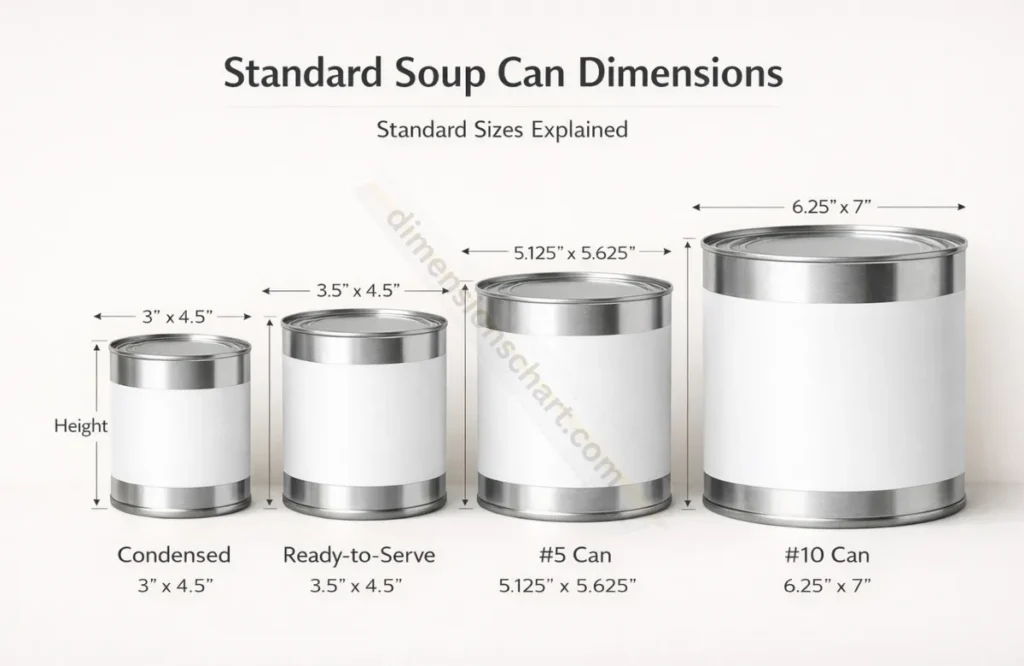
Not all soup cans are the same size. The standard soup can dimensions depend on whether the soup is condensed, ready-to-serve, or bulk format. Here’s a closer look at each type.
Condensed Soup Can Dimensions (10.75 oz)
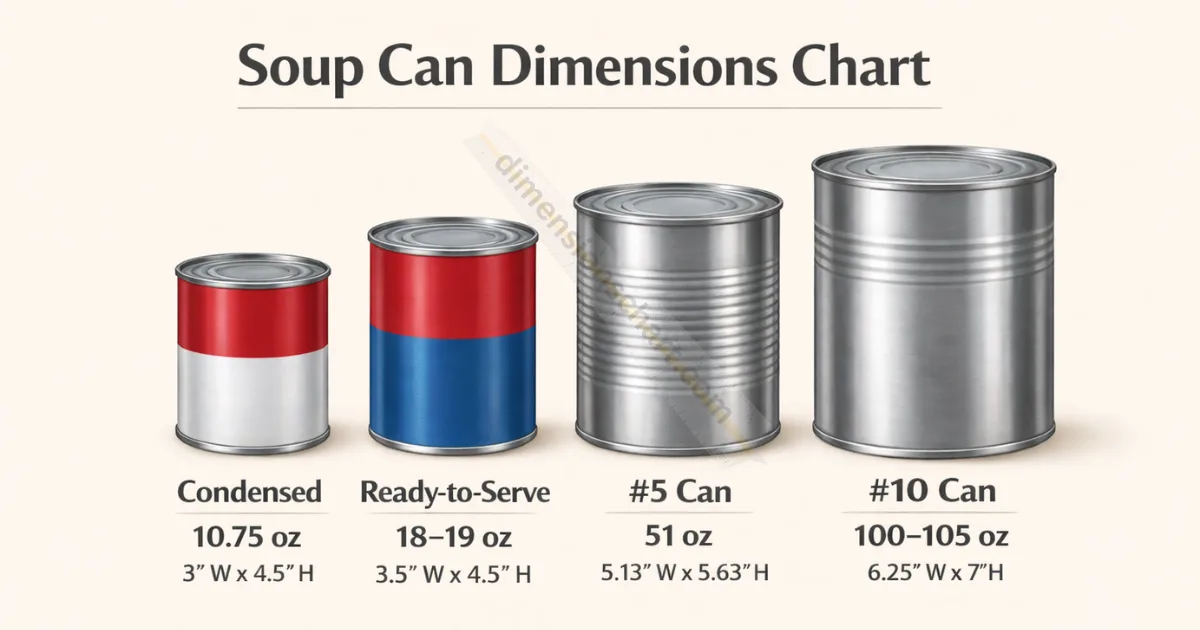
The condensed soup can is the most common size in the U.S. It measures 3 inches in diameter and 4.5 inches in height, with a capacity of 10.5 to 10.75 oz.
Campbell’s Condensed uses this exact 300×407 can size and has kept these dimensions consistent for decades. Store brands follow the same specs for full shelf compatibility.
Ready-to-Serve Soup Can Dimensions (18–19 oz)
Ready-to-serve soup cans are slightly wider — measuring 3.5 inches in diameter and still 4.5 inches tall. They hold 18 to 19 oz of soup with no water needed.
Brands like Progresso and Campbell’s Chunky use this 307×409 can size. Because the soup is pre-diluted, these cans hold roughly twice the serving volume of condensed cans.
Large Format Soup Can Dimensions (#5 and #10 Cans)
The #5 can holds around 51 oz and is used in bulk soup, chili, and foodservice sauces. It stands 5.625 inches tall with a 5.125-inch diameter.
The #10 can is the largest standard size — measuring 6.25 inches wide and 7 inches tall. It holds 100 to 105 oz, or about 12–13 cups. Used widely in restaurant kitchens, cafeterias, and institutional catering.
| Visual | Can Type | Diameter (in) | Height (in) | Diameter (cm) | Height (cm) | Capacity (ml) |
|---|---|---|---|---|---|---|
| Condensed | 3.0 in | 4.5 in | 7.6 cm | 11.4 cm | 295–318 ml | |
| Ready-to-Serve | 3.5 in | 4.5 in | 8.9 cm | 11.4 cm | 532–562 ml | |
| #2.5 Can | 4.01 in | 4.11 in | 10.2 cm | 10.4 cm | 828 ml | |
| #5 Can | 5.125 in | 5.625 in | 13.0 cm | 14.3 cm | ~1,509 ml | |
| #10 Can | 6.25 in | 7.0 in | 15.9 cm | 17.8 cm | ~2,960 ml |
Soup Can Capacity and Serving Sizes
Soup can capacity tells you how much liquid a can actually holds — but that’s not the same as how many servings it gives you. The USDA defines one serving of soup as 1 cup (8 fluid ounces).
A single 10.75 oz condensed can only contains about 1.3 cups before preparation. Once you add water or milk as directed, it yields approximately 2.5 cups — or 2 to 3 servings.
How Many Cups Are in Each Soup Can Size?
Knowing the cup capacity of each can size is critical for recipe scaling. A #10 can holds 12 to 13 cups — the equivalent of six standard ready-to-serve cans combined.
Here is the complete soup can capacity and serving chart for every standard U.S. can size:
| Can Type | Total Oz | Total Cups | Servings (USDA) | After Prep (oz) |
|---|---|---|---|---|
| Condensed (10.75 oz) | 10.75 oz | ~1.3 cups | ~1.3 servings | ~20 oz (add water) |
| Ready-to-Serve (18–19 oz) | 18–19 oz | ~2.25 cups | ~2 servings | No prep needed |
| #2.5 Can (28 oz) | 28 oz | ~3.5 cups | ~3.5 servings | No prep needed |
| #5 Can (51 oz) | 51 oz | ~6.4 cups | ~6 servings | No prep needed |
| #10 Can (102–105 oz) | 102–105 oz | ~12–13 cups | ~12 servings | No prep needed |
Fluid ounces measure volume. Net weight measures mass. These numbers differ on soup cans because soup contains solids like vegetables, noodles, and meat that are denser than water.
For example, a chunky soup can labeled 18.6 oz net weight may only contain about 17.5 fl oz of liquid volume. Always check the nutrition label serving size for the most accurate portion data.
Soup Can Storage: Pantry, Cabinet, and Refrigerator Guide
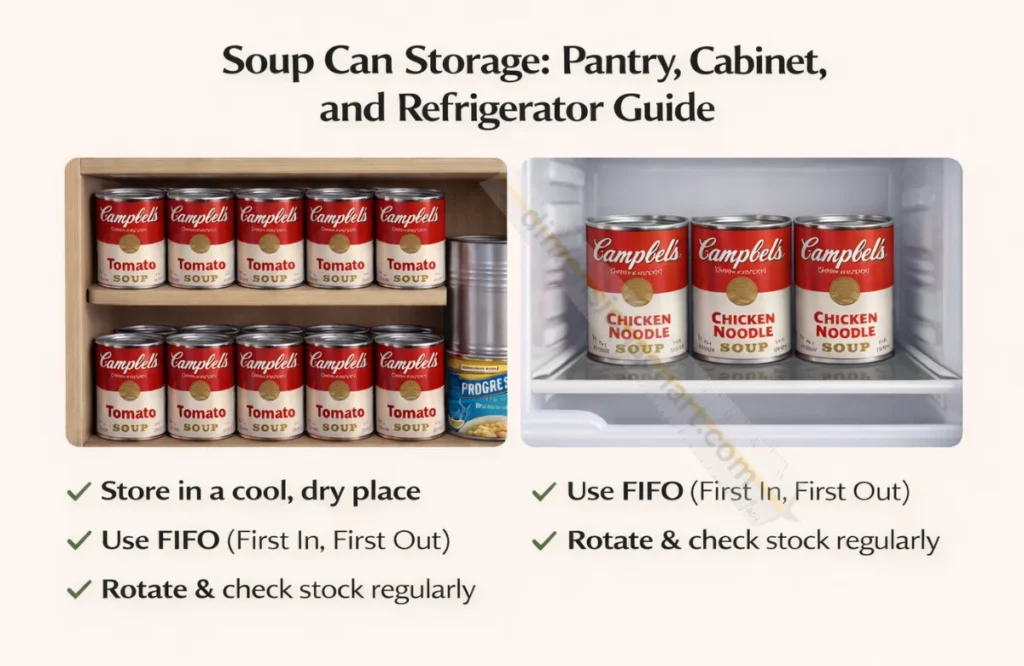
Understanding soup can storage goes beyond just stacking cans on a shelf. The right setup protects the cans, maximizes space, and keeps your pantry organization efficient for everyday use.
According to the USDA, commercially canned soups remain safe for 2 to 5 years when stored properly in a cool, dry location away from direct sunlight and temperature extremes.
| Can Size | Diameter | Cans Per 12″ Shelf Row | Max Stack Height | Shelf Space Needed |
|---|---|---|---|---|
| Condensed (300×407) | 3.0 in | 4 cans across | 3 cans high (13.5 in) | Low — fits most shelves |
| Ready-to-Serve (307×409) | 3.5 in | 3 cans across | 2 cans high (9 in) | Standard — easy to store |
| #2.5 Can | 4.01 in | 3 cans across | 2 cans high (8.2 in) | Moderate — mid-depth shelf |
| #5 Can | 5.125 in | 2 cans across | 1–2 cans high | Large — needs deep shelf |
| #10 Can | 6.25 in | 1–2 cans across | 1 can high (7 in) | Bulk — requires dedicated space |
How to Store Opened Soup Cans Correctly
Never store leftover soup in an open can in the refrigerator. Direct contact between food and the metal interior can cause a metallic taste and accelerate spoilage.
Transfer opened soup into a glass or BPA-free plastic container and refrigerate immediately. Refrigerated soup stays safe for 3 to 4 days regardless of the original can size. For longer storage, freeze in portion-sized containers.
Best Practices for Long-Term Soup Can Storage
Store cans in a location where the temperature stays between 50°F and 70°F (10°C–21°C). Heat above 100°F (38°C) can damage the can lining and reduce shelf life significantly.
Follow the FIFO method — First In, First Out. Place newer cans behind older ones so you always use the oldest stock first. Rotate your pantry stock every 6 to 12 months for best freshness.
Conclusion
This soup can dimensions chart covers every standard size — from the compact 10.75 oz condensed can to the bulk #10 food service can.
Knowing the exact soup can height, width, and capacity helps you plan meals, manage pantry space, and scale recipes with confidence. Bookmark this guide and never second-guess a can size again.
FAQ’s
What are the dimensions of a soup can?
A standard condensed soup can measures 3 inches in diameter and 4.5 inches tall, holding 10.5 to 10.75 oz. Ready-to-serve varieties are slightly larger at 3.5 inches wide and 4.5 inches high, holding 18 to 19 oz.
What are the dimensions of a standard can?
A standard food can in the U.S. follows the 300×407 size code — roughly 3 inches in diameter and 4.4 to 4.5 inches in height. However, “standard” shifts by product type — condensed and ready-to-serve soups use different diameters.
What is a normal sized can of soup?
The most common soup can in American kitchens is the 10.75 oz condensed soup can — 3 inches wide and 4.5 inches tall. Ready-to-serve 18–19 oz cans come in second as the most frequently purchased size on U.S. grocery shelves.
How tall is a can of soup in CM?
A standard soup can stands approximately 11.4 cm tall (equal to 4.5 inches). Condensed cans are 7.6 cm in diameter while ready-to-serve cans measure approximately 8.9 cm wide.
What is the height and width of a can?
For a condensed soup can: height is 4.5 inches (11.4 cm) and width is 3 inches (7.6 cm). For ready-to-serve cans: the height stays at 4.5 inches but the width increases to 3.5 inches (8.9 cm).
How big is a tin of soup?
A typical U.S. tin of soup is 3 to 3.5 inches wide and 4.5 inches tall, holding 10.75 to 19 oz. Large food service tins like the #10 can measure 6.25 inches wide and 7 inches tall, holding up to 105 oz.

Burhan Ali is the founder and author of DimensionsChart.com, providing accurate size charts, measurements, and guides for smarter buying decisions.